Showing posts with label Central Java. Show all posts

Wednesday, September 18, 2013

Tegal, Central Java

Tegal, Central Java

Tegal, Central Java
Tegal, Central Java
The city of Tegal developed from a small village called Tetegual. The modernization of the village began in the early 1530s, and it eventually became part of the Pemalang Regency, which admitted the existence of the Pajang Empire in Central Java. The Pajang Empire was the successor of the Sultanate of Demak.
The city was founded by Ki Gede Sebayu. Together with the local people, he aspired to increase the region’s agriculture, exploiting its fertile soil. Because of his efforts to develop the region, he became the high leader and the symbol of the city. His coronation as leader was held simultaneously with a traditional festival celebrating a rich agricultural harvest. In accordance with district ordinance no. 5/1988, July 28 is the anniversary of the city of Tegal.
In the 1920s, the city was a center of activism for the Communist Party of Indonesia, and the radical leaders of the Tegal branch of the PKI were among the instigators of the 1926 rebellion that led to the temporary destruction of that party.
On October 8, 1945, an anti-feudalism movement called Gerakan Tiga Daerah was established in Tegal, Pekalongan, and Brebes. Its goal was to replace the blue-blood regents (related to the kings of Yogyakarta and Surakarta) with ordinary people. According to the leaders of this movement, the old regents had cooperated with the Japanese during the world war II and sent people to Japanese slave labor camps. The main leader of Gerakan Tiga Daerah was Sarjiyo, who became the new regent of Pekalongan. Others were Kutil, K. Mijaya and Ir. Sakirman. Ir Sakirman was the local leader of the PKI. The government of the Republic of Indonesia in Yogyakarta opposed Gerakan Tiga Daerah and declared it illegal.
Gerakan Tiga Daerah had the old regents arrested, stripped naked and dragged into prison. Other government officials and police officers were kidnapped and massacred at Talang bridge. The Gerakan Tiga Daerah also started a racial riot against ethnic Chinese in Brebes. On November 4, 1945, the movement attacked the Indonesian army headquarters and the regent office in Pekalongan. The rebels were defeated by the Indonesian army in a fierce battle on December 21, 1945, and most of their leaders were arrested and imprisoned. This rebellion is called the Three Regions Affair.
During the unrest following the resignation of President Suharto in 1998, Tegal was the site of extensive protests and occasional violence against local government officials, especially in June 1998.
Tegal has its own language, known as Bahasa Tegal. Some Indonesian comedians speak it because its accent and dialect arouse amusement. The greeting "How are you?" translates to "Kepriben kabare?"
It is common practice for people in Tegal to call their friends "Jon", "Jack" or "Jakwir". The translation for "Daddy" is Jasak, "Mommy" is Jok, a younger brother is addressed as Yarig and an older brother as Sahang. Many other words can only be understood by native Tegals. Bahasa Tegal also has many Arabic loan words.

Related Sites for Tegal, Central Java

Tuesday, September 10, 2013

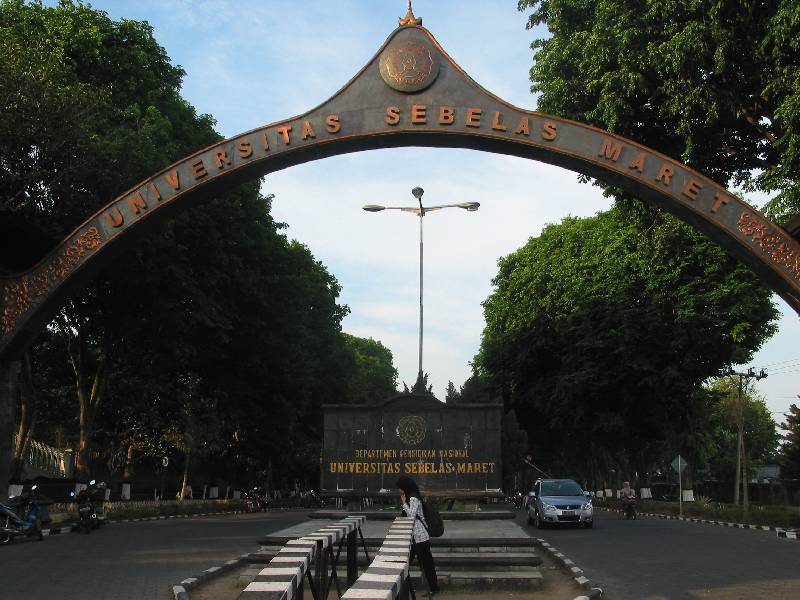
Sebelas Maret University, Indonesian public university, Surakarta, Central Java, Indonesia

Sebelas Maret University

Sebelas Maret University
Sebelas Maret University is an Indonesian public university in the suburban area of Surakarta, Central Java, Indonesia. It is colloquially known as UNS or UNS Solo.
Sebelas Maret UniversityThe symbol of UNS is a flower with four petals as the visualization of the nation, the name of the nation and the state.The three petals at top side, right side and the left side are the embodiment of tri dharma colleges. The one petal under consists of five units that symbolize the principles of Pancasila.The four petals form a line in sequence to depict the academic unity of UNS.
The flower's pistil head shape is described as Wiku that derives from Pali, meaning "the learned people", a circular writing that is similar with Javanese script is Sangkala Candra, "Mangesthi Luhur Ambangun Nagara" symbolizes the Java year 1908 or 1976 AD, the founding year of UNS.
Sebelas Maret UniversityOverall the symbol of UNS visualize ideals to build a nation, Candra Sangkala it as a shining Praba, Praba in the history of religion and puppet used by the holy man who's wise and virtuous. The central of symbol is Wiku brain is described as a flame, suggests light that illuminates the eternity of science, toward human welfare. Navy blue's colour is a pledge of allegiance and devotion to nation, state, homeland, and science.
The university has nine faculties providing courses at the diploma, undergraduate, professional, and specialist levels. Some graduate and postgraduate courses are managed by the graduate program.
Students mostly come from outside of Surakarta. The Family Medicine master's program received equipment from the Ministry of Health to develop a model of family clinic services, which provide health services, supported the concept of health insurance/Public Health Maintenance Insurance. UNS-MC will be used to support teaching and learning activities for the practicum for students Faculty of Medicine and Family Medicine. Participants are students, employees, lecturers, and communities around the campus.
UNS is supported by more than 1,600 lecturers; 4% of them are professors, and 72.9% of them hold either a bachelor's degree or master's degree. It is supported by approximately 900 administrative staff.
IT facilities at the university are the internet network at the university and in each faculty. UNS provides web hosting for each faculty and department which intends to build a website as a sub-domain of www.uns.ac.id. Email is provided free for the academic community UNS. UNS develops Academic Information System, an educational information technology-based system, so that student registration and Plan Studies Consultation can be performed online.
In the Central Library, UNS is developing UNS Library Automation to ease the reference and collections search through online media. The library can be searched via the Internet. The library is equipped with a Digital Library, a reference that can be accessed online. UNSLA is the online catalog (only searching the library collection) while the Digital Library serves as a digital reference database (all information from a scientific work can be accessed here).
The Educational Development Institute develops educational activities online or E-Learning. Other IT facilities are hot spot and the SAT, to anticipate those who don't have a notebook, UNS has been providing Self Access Terminal (SAT), PC Desktop internet service. Because the number of PCs are still limited, the users are very low charged to avoid the monopoly use of a PC. SAT is also reserved for those who wish to develop skills in ICT.
As a health concern, UNS established the Medical Center serving the UNS academic community and people around the campus as a form of community service. It consists of four divisions: Public Health, Dental, ENT, and Eye. The Medical Center is supported by doctor and medical personnel, lecturers at the Faculty of Medicine. In addition to the health service center, UNS Medical Center serves as a supporting facility for teaching and learning activities for students of Faculty of Medicine.
Student facilities include sports and arts facilities, dormitory, and the Secretariat of SMEs. In sports and arts facilities, UNS has a national standard football stadium with stands, players changing rooms, as well as athletic tracks that are for athletes and for sports learning. The closed sports arena can be used for indoor sports, such as volleyball, badminton, basketball and futsal.
UNS has a Student Center UNS which can be used for academic activities like seminars, workshops, or meetings with a large-scale participant as well as sports activities such as Tae Kwon Do, Jiu Jit Su, Karate, Pencak Silat, etc. UNS has tennis courts in Kentingan and in the Department of Sports Education and Health at Manahan. Sport facilities are scattered in every faculty such as basketball court, volleyball, and badminton.
For the convention hall, UNS has an auditorium with amenities for academic and entertainment activities such as art performances or music concerts. Traditional Karawitan equipment, equipment for modern music, and marching bands are student facilities. UNS builds secretariats for Student Activity Unit at the university and faculty level. UNS has a student dormitory with full residential facilities. Students may live in the dormitory at low cost.
Bus Campus is another facility that can be used in student activities, within and outside the campus with permits that have been set by the institution.
Nurul Huda Mosque is the largest mosquein campus. UNS has other mosques in Kentingan, Manahan, Kleco, and Pabelan. Nurul Huda Mosque is located in the campus center, Kentingan. It was established in 1982. Besides functioning as a means of worship, Nurul Huda Mosque serves as a means to instill the values of Islam to the campus community, especially Muslim students. For other religions, UNS has a church for Christians, Pura for Hindus, and monastery for Buddhists.

Related Sites for Sebelas Maret University

Sunday, September 8, 2013

State University of Semarang, Public University in Semarang, Central Java, Indonesia

State University of Semarang

State University of Semarang
The State University of Semarang is a public university in the city of Semarang, Central Java, Indonesia. The university is located in Gunungpati, a highland area of Semarang, Central Java.
Unnes has eight faculties: Education, Language and Arts, Social Sciences, Mathematics and Science, Engineering, Sport Science, Economics, and Law.
State University of SemarangSemarang State University was established in 1965 in Semarang, the old town which is the provincial capital of Central Java. With six colleges and one graduate program, Unnes educates around 21,000 students who are scattered in the levels of Diploma, Bachelor, and Post-Graduate.
BI Course and Course B-II Middelbaar Onderwijzer A Cursus and Middelbaar Onderwijzer B Cursus (MO-B) is an educational institution set up by the Dutch colonial government aims to prepare teacher's SMTP and SMTA. Course MO MO-A and-B was held in Semarang until 1950. MO Course be Course BI-A and MO-B Course Course B-II made that held until 1960.
State University of SemarangExtension Course and IKIP Tegal, Semarang branch. Founded in several places, both inside and outside the city of Hyderabad to meet the aspirations of primary teachers, SMTP and SMTA who want to continue studies teacher at the Teachers' Training College Hyderabad.
Integration of educational institutions and the Cultural Construction Updates and Tinggo School Sports (STO) LP3K established by the Ministry of Education and Culture with the aim to relevance formal education in the villages.

Related Sites for State University of Semarang

Friday, August 30, 2013

Central Java : A Province of Indonesia

Central Java

Central Java

Central Java is a province of Indonesia. It forms the middle portion of the island of Java. The administrative capital is Semarang.
Central Java is also a cultural concept that includes the Special Region and city of Yogyakarta. However, administratively the city and surrounding region has been part of a separate special region since Indonesian independence.
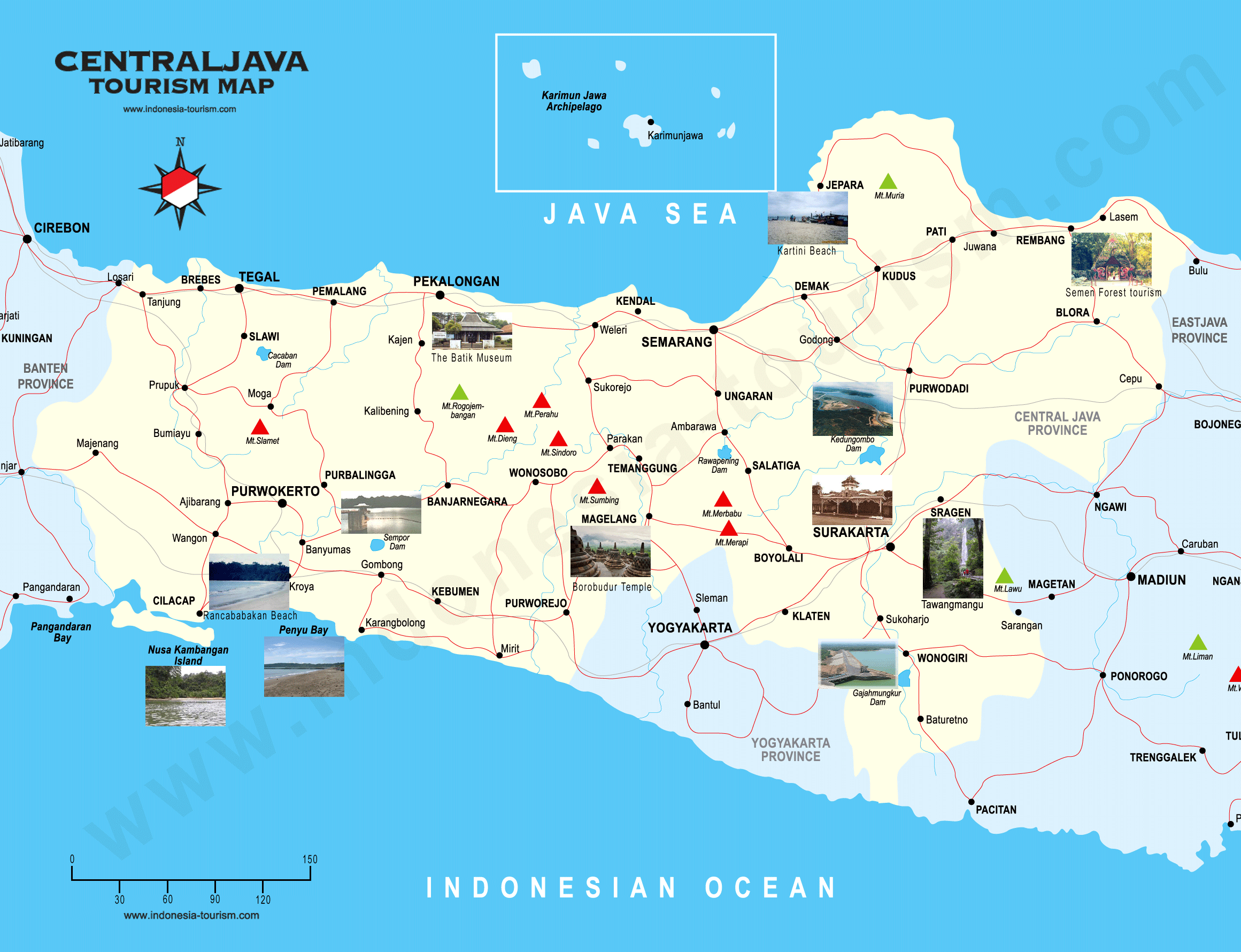
Located in the middle of the island of Java, the Central Java province is bordered by West Java and East Java provinces. A small portion of its south region is the Yogyakarta Special Region province, fully enclosed on the landward side by the Central Java province. To the north and the south, the Central Java province faces the Java Sea and the Indian Ocean. Central Java includes offshore islands such as Karimun Jawa Islands in the north, and Nusakambangan in the southwest. Yogyakarta is historically and culturally part of the Central Java region, although it is now a separate administrative entity.
Central JavaThe geography of Central Java is regular with small strips of lowlands near the northern and southern coast with mountain ranges in the centre of the region. To the west lies an active stratovolcano Mount Slamet, and further east is the Dieng Volcanic Complex on Dieng Plateau. Southeast of Dieng lies the Kedu Plain, which is bordered to the east side by the twin volcanoes of Mount Merapi and Mount Merbabu. South of Semarang, lies Mount Ungaran, and to the north-east of the city lies Mount Muria on the most northern tip of Java. To the east near the border with East Java lies Mount Lawu, where its eastern slopes are in the East Java province.
Due to its active volcanic history, volcanic ash makes Central Java highly fertile agriculture land. Paddy fields are extensive, except in the southeastern Gunung Kidul region partly due to the high concentration of limestone and its location in a rain shadow from the prevailing weather.
The largest rivers are the Serayu in the west, which empties into the Indian Ocean, and the Solo which flows into East Java.
On the eve of the World War II in 1942, Central Java was subdivided into 7 residencies which corresponded more or less with the main regions of this area. These residencies were Banjoemas, Kedoe, Pekalongan, Semarang, and Djapara-Rembang plus the so-called Gouvernement Soerakarta and Gouvernement Jogjakarta. However after the local elections in 1957 the role of these residencies were reduced until they finally disappeared.
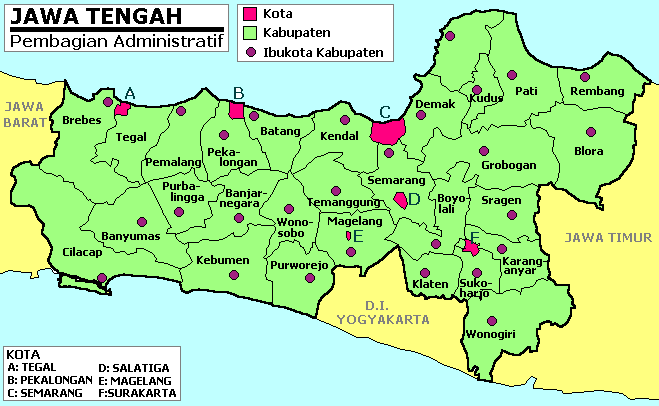
Nowadays Central Java is divided into 29 regencies (kabupaten) and 6 cities (kota, previously kotamadya and kota pradja), the latter being independent of any regency. These contemporary regencies and cities can further be subdivided into 565 districts (kecamatan). These districts are further subdivided into 7,804 rural communes or "villages" (desa) and 764 urban communes (kelurahan).
Java has been inhabited by humans or their ancestors since prehistorical times. In Central Java and the adjacent territories in East Java remains known as "Java Man" were discovered in the 1890s by the Dutch anatomist and geologist Eugxne Dubois. Java Man belongs to the species Homo erectus. They are believed to be about 1.7 millions years old.
Then about 40,000 years ago, Australoid peoples related to modern Australian Aboriginals and Melanesians colonised Central Java. They were assimilated or replaced by Mongoloid Austronesians by about 3000 BC, who brought with them technologies of pottery, outrigger canoes, the bow and arrow, and introduced domesticated pigs, fowls, and dogs. They also introduced cultivated rice and millet.
Recorded history began in Central Java in the 7th century AD. The writing, as well as Hinduism and Buddhism, were brought to Central Java by Indians from South Asia. Central Java was a centre of power in Java back then.
In 664 AD, the Chinese monk Hui-neng visited the Javanese port city he called HÄ"lxng or Ho-ling, where he translated various Buddhist scriptures into Chinese with the assistance of the Javanese Buddhist monk Jxānabhadra. It isn't precisely known what is meant by the name HÄ"lxng. It used to be considered the Chinese transcription of Kalinga but it now most commonly thought of as a rendering of the name Areng. HÄ"lxng is believed to be located somewhere between Semarang and Jepara.
The 1st dated inscription in Central Java is the Inscription of Canggal which is from 732 AD. This inscription which hailed from Kedu, is written in Sanskrit in Pallava script. In this inscription it is written that a Shaivite king named Sri Sanjaya established a kingdom called Mataram. Under the reign of Sanjaya's dynasty several monuments such as the Prambanan temple complex were built.
In the meantime a competing dynasty arose, which adhered to Buddhism. This was the Sailendra dynasty, also from Kedu, which built the Borobudur temple.
After 820 there is no more mention of HÄ"lxng in Chinese records. This fact coincides with the overthrow of the Sailendras by the Sanjayas who restored Shaivism as the dominant religion. Then in the middle of the 10th century, for unknown reason, the centre of power moved to Eastern Java.
A few centuries later, after the destruction of the great Hindu Majapahit Empire in the 15th - 16th centuries by the Central Javanese Muslim kingdom of Demak, the Javanese centre of power moved back to Central Java. In the meanwhile European traders began to frequent Central Javanese ports. The Dutch established a presence in the region through their East India Company.
After Demak itself collapsed, a new kingdom on the Kedu Plain emerged. This new kingdom, which was also a sultanate, bore the old name of Mataram. Under the reign of Sultan Agung, Mataram was able to conquer almost all of Java and beyond by the 17th century, but internal disputes and Dutch intrigues forced Mataram to cede more and more land to the Dutch. These cessions finally led to several partitions of Mataram. The 1st partition was after the 1755 Treaty of Giyanti. This treaty divided the old kingdom in two, the Sultanate of Surakarta and the Sultanate of Yogyakarta. Then few years later Surakarta was divided again with the establishment of the Mangkunegaran after the Treaty of Salatiga.
During the Napoleonic Wars in Europe, Central Java, as part of the Netherlands East-Indies, a Dutch colony, was handed over to the British. In 1813, the Sultanate of Yogyakarta was also divided with the establishment of the Pakualamanan.
After the British left, the Dutch came back, as decided by the Congress of Vienna. Between 1825 - 1830 the Java War ravaged Central Java. The result of the war was a consolidation of the Dutch power. The power and the territories of the divided kingdom of Mataram were greatly reduced.
However Dutch rule brought modernization to Central Java. In the 1900s the modern province of Central Java, the predecessor of the current one was created. It consisted of five regions or gewesten in Dutch. Surakarta and Yogyakarta were autonomous regions called Vorstenlanden. Then after the Indonesian independence the province of Central Java was formalized on August 15, 1950, excluding Yogyakarta but including Surakarta. Since then there have been no (major) changes in the administrative division of Central Java.
In 1998, preluding the downfall of president Suharto, anti Chinese violence broke out in Surakarta and surrounding areas. Much Chinese property and other buildings were burnt down. In 1999, public buildings in Surakarta were burnt again by supporters of Megawati Soekarnoputri after the Indonesia parliament chose Abdurrahman Wahid instead of Soekarnoputri. They carried out 'sweeping actions' against Western foreigners who reside in this city after the September 11, 2001 attacks.
The May 2006 Java earthquake in the south and Yogyakarta devastated many buildings and caused thousands of deaths and more than 37,000 injuries. Today, some areas are still under reconstruction.
As of the 2010 census, Central Java's population stood at some 32,380,687. As of the 1990 census, the population was 28,516,786. So the population has increased approximately 13.5% in 20 years.
The three biggest regencies in terms of population are: Brebes, Banyumas and Cilacap. Together these regencies make up approximately 16% of the Central Javanese population. Major urban population centres are Greater Semarang, Greater Surakarta and the Brebes-Tegal-Slawi area in the north-west of the province.

Related Sites for Central Java
Saturday, August 24, 2013

History of Medang (Mataram) Kingdom in Central Java

Medang Kingdom

The Medang or Mataram Kingdom was a Hindu–Buddhist kingdom that flourished between the 8th and 10th centuries CE. It was based in Central Java, and later in East Java. Established by King Sanjaya, the founder of the Sanjaya dynasty, the kingdom was ruled by the Sailendra and Sanjaya families. By 850, the kingdom had become the dominant power in Java and was a serious rival to the hegemonic Srivijaya Empire.
Medang KingdomMedang KingdomThe earliest account of the Medang Kingdom is in the Canggal inscription, dated 732, discovered in Canggal village, southwest of the town of Magelang. This inscription, written in Sanskrit using the Pallava script, tells of the erection of a lingga on the hill in the Kunjarakunja area, located on a noble island called Yawadwipa (Java) which was blessed with abundance of rice and gold. This inscription tells that Yawadwipa was ruled by King Sanna, whose long reign was marked by wisdom and virtue. After Sanna died, the kingdom fell into disunity. Sanjaya, the son of Sannaha (Sanna's sister) ascended to the throne. He conquered the areas around his kingdom, and his wise reign blessed his land with peace and prosperity for all of his subjects.
Sanna and Sanjaya are
Parahyangan, a book from a later
the history of Pasundan .
Sanna was defeated by
retreated to Mount Merapi. Later,
kingdom and ruled West Java,
Bali. He also battled the
their king, Sang Srivijaya).
also described in the Carita
period which mainly describes
This book mentions that
Purbasora, King of Galuh, and
Sanjaya reclaimed Sanna's
Central Java, East Java, and
Malayu and Keling (against
-
Bosch in his book "Srivijaya, de Sailendravamsa en de Sanjayavamsa" suggested that king Sanjaya was the progenitor of the Sanjaya Dynasty, and there was two dynasties that ruled Central Java; the Buddhist Sailendra and the Shivaist Sanjaya dynasty. The inscription also states that Sanjaya was an ardent follower of Shaivism. From its founding in the early 8th century until 928, the kingdom was ruled by the Sanjaya dynasty. The 1st king was Sanjaya, who ruled in the Mataram region in the vicinity of modern Yogyakarta and Prambanan, and left the written records on the Canggal inscription. However, around the mid 8th century, the Sailendra dynasty emerged in Central Java and challenged Sanjaya domination in the region.
According to the
CE and written in the
Kalasan temple was erected by
Sailendravamxatilaka , who persuaded
to construct a holy
(boddhisattvadevi) Tara and build a vihara
the Sailendra realm.
village to a sangha (Buddhist
Kalasan inscription, dated 778
Pranagari script in Sanskrit, the
the will of Guru Sang Raja
Panangkaran (Sanjaya's successor)
building for the goddess
(monastery) for Buddhist monks from
Panangkaran also awarded Kalaxa
monastic community).
The prevailing historical interpretation holds that the Sailendra dynasty co-existed next to the Sanjaya dynasty in Central Java, and much of the period was characterized by peaceful cooperation. The Sailendra, with their strong connections to Srivijaya, managed to gain control of Central Java and become overlords of the Rakai , including the Sanjayas, thus making the Sanjaya kings of Mataram their vassals. Little is known about the kingdom due to the dominance of the Sailendra, who during this period constructed Borobudur, a Buddhist monument. Samaratungga, the monarch of the Sailendra, tried to secure the Sailendra position in Java, cementing an alliance with the Sanjayas by arranging the marriage of his daughter Pramodhawardhani with Pikatan.
Around the middle of the
between the Sanjaya and the
the Sanjaya ruler,
the offspring of the
and the princess Tara. This
in Java; Balaputra
capital in Sumatra, where he
The Balaputra defeat and
recorded in Shivagrha
Rakai Kayuwangi, Pikatan's
9th century, relations
Sailendra deteriorated. In 852,
Pikatan, defeated Balaputra,
Sailendra monarch Samaratunga
ended the Sailendra presence
retreated to the Srivijayan
became the paramount ruler.
the victory of Pikatan was
inscription dated 856, edicted by
successor.
However, this dual
proposed by Bosch and De Casparis
Indonesian historians in later
proposed by Poerbatjaraka,
kingdom and one dynasty, the
capital in the Mataram area , and
the Sailendra.
Sailendra—Sanjaya dynasties theory
was opposed by some
period. An alternate theory,
suggests there was only one
kingdom called Medang, with the
the ruling dynasty being
-
This theory is supported with Boechari interpretation on Sojomerto inscription and Poerbatjaraka study on Carita Parahyangan manuscript, Poerbatjaraka holds that Sanjaya and all of his offspring belongs to the Sailendra family, which initially was Shivaist Hindu. However, according to Raja Sankhara inscription ; Sanjaya's son, Panangkaran, converted to Mahāyāna Buddhism. And because of that conversion, the later series of Sailendra kings who ruled Medang become Mahāyāna Buddhists also and gave Buddhism royal patronage in Java until the end of Samaratungga's reign. The Shivaist Hindus regained royal patronage with the reign of Pikatan, which lasted until the end of the Medang Kingdom. During the reign of Kings Pikatan and Balitung, the royal Hindu Trimurti temple of Prambanan was built and expanded in the vicinity of Yogyakarta.
Most of the time, the
was located in Mataram,
near modern Yogyakarta and
reign of Rakai Pikatan, the
Later, in the reign of
this time to Poh Pitu. Unlike
unable to pinpoint the exact
although most historians agree
Kedu Plain, somewhere
Temanggung regencies. Later,
court was moved back to the
court of the Medang Kingdom
somewhere on the Prambanan Plain
Prambanan. However, during the
court was moved to Mamrati.
Balitung, the court moved again,
Mataram, historians have been
locations of Mamrati and Poh Pitu,
that both were located in the
around the modern Magelang or
during the reign of Wawa, the
Mataram area.
The complex stratified
refined aesthetic taste in art
through the various scenes in
various temples dated from the
ancient Javan society, with its
and culture, is evidenced
narrative bas-reliefs carved on
Medang era.
The common people of Medang mostly made a living in agriculture, especially as rice farmers, however, some may have pursued other careers, such as hunter, trader, artisan, weaponsmith, sailor, soldier, dancer, musician, food or drink vendor, etc. Rich portrayals of daily life in 9th century Java can be seen in many temple bas-reliefs. Rice cultivation had become the base for the kingdom's economy where the villages throughout the realm relied on their annual rice yield to pay taxes to the court. Exploiting the fertile volcanic soil of Central Java and the intensive wet rice cultivation enabled the population to grow significantly, which contributed to the availability of labor and workforce for the state's public projects. Certain villages and lands were given the status as sima (tax free) lands awarded through royal edict written in inscriptions. The rice yields from sima lands usually were allocated for the maintenance of certain religious buildings.
The bas-reliefs from temples of this period, especially from Borobudur and Prambanan describe occupations and careers other than agricultural pursuit; such as soldiers, government officials, court servants, massage therapists, travelling musicians and dancing troupe, food and drink sellers, logistics courier, sailors, merchants, even thugs and robbers are depicted in everyday life of 9th century Java. These occupations requires economy system that employs currency. The Wonoboyo hoard, golden artifacts discovered in 1990, revealed gold coins in shape similar to corn seeds, which suggests that 9th century Javan economy is partly monetized. On the surface of the gold coins engraved with a script "ta", a short form of "tail" or "tahil" a unit of currency in ancient Java.
The King was regarded as the paramount ruler or chakravartin, where the highest power and authority lies. The king, the royal family and the kingdom's officials had the authority to launch public projects, such as irrigation works or temple construction. The kingdom left behind several temples and monuments. The most notable ones are Prambanan, Sewu, and the Plaosan temple compound. The palace where the King resided was mentioned as kadatwan or keraton, the court was the center of kingdom's administration. Throughout its history, the center of Medang kingdom was mostly situated in and around Prambanan Plain, named as Mataram, however during the reign of other kings, the capital may shifted to other places. Several other courts and capital cities were mentioned, such as Mamrati and Poh Pitu, location unknown but probably somewhere in Kedu Plain. In later Eastern Java period, other centers were mentioned; such as Tamwlang and Watugaluh (near Jombang), also Wwatan (near Madiun).
The Wonoboyo hoard
to the wealth, art, and
achievement of the Medang Kingdom.
intricate artwork and technical
goldsmith. The hoard was estimated
King Balitung. The treasure
belonging to a noble or a member of
golden artifacts also attest
culture as well as the aesthetic
The artifacts show the
mastery of the ancient Javanese
to date from the reign of
has been identified as
the royal family.
Since the beginning of
Mataram kings seemed to favour
construction of Gunung Wukir Hindu
inscription by king Sanjaya.
Panangkaran and the rise of
Buddhism began to blossomed and
Kalasan, Sari, Mendut, Pawon and
and Sewu temples testify
in Central Java. The court
from the reign of
During the reign of Pikatan,
regain court's favour,
grand Shivagrha .
its formation, the Medang
Shivaist Hinduism, such as the
temple as mentioned in Canggal
However during the reign of
Sailendras influence, Mahayana
gain court favour. The
the magnificent Borobudur
the Buddhist renaissance
patronage on Buddhism spanned
Panangkaran to Samaratungga.
Shivaist Hinduism began to
signified by the construction of
-
Other Hindu temples dated from Medang Mataram Kingdom era are: Sambisari, Gebang, Barong, Ijo, and Morangan. Although the Shivaist regain the favour, buddhist remain under royal patronage. The Sewu temple dedicated for Manjusri according to Kelurak inscription was probably initially built by Panangkaran, but later expanded and completed during Rakai Pikatan's rule, whom married to a Buddhist princess Pramodhawardhani, daughter of Samaratungga. Most of their subjects retained their old religion; Shivaist and Buddhist seems to co-exist in harmony. The buddhist temple of Plaosan, Banyunibo and Sajiwan were built during the reign of King Pikatan and Queen Pramodhawardhani, probably in the spirit of religious reconciliation after the battle of succession between Pikatan-Pramodhawardhani against Balaputra.
From the 9th to mid 10th centuries, the Medang Kingdom witnessed the blossoming of art, culture and literature, mainly through the translation of Hindu-Buddhist sacred texts and the transmission and adaptation of Hindu-Buddhist ideas. The bas-relief narration of the Hindu epic Ramayana was carved on the wall of Prambanan Temple. During this period, the Kakawin Ramayana, an old Javanese rendering was written. This Kakawin Ramayana, also called the Yogesvara Ramayana, is attributed to the scribe Yogesvara circa the 9th century CE, who was employed in the court of the Medang in Central Java. It has 2774 stanzas in the manipravala style, a mixture of Sanskrit and archaic Javanese prose. The most influential version of the Ramayana is the Ravanavadham of Bhatti, popularly known as Bhattikavya. The Javanese Ramayana differs markedly from the original Hindu.
The name of the Medang
Laguna Copperplate
discovered in Manila,
inscriptions, written in the Kawi
containing numerous loanwords
non-Malay vocabulary elements
between Old Javanese and Old
people or officials of the
inter-insular trade and foreign
the Philippines, and that
kingdoms in Indonesia and the
Kingdom was written in the
Inscription, dated 822 saka ,
Philippines. The discovery of the
script in a variety of Old Malay
from Sanskrit and a few
whose origin is ambiguous
Tagalog, suggests that the
Medang Kingdom had embarked on
relations in regions as far away as
connections between ancient
Philippines existed.
Around the year 929, the centre of the kingdom was shifted from Central Java to East Java by Mpu Sindok, who established the Isyana Dynasty. The exact cause of the move is still uncertain; however, a severe eruption of Mount Merapi volcano or a power struggle probably caused the move. Historians suggest that, some time during the reign of King Wawa of Mataram , Merapi volcano erupted and devastated the kingdom's capital in Mataram. The historic massive volcano eruption is popularly known as Pralaya Mataram (the death of Mataram). The evidence for this eruption can be seen in several temples that were virtually buried under Merapi's lahar and volcanic debris, such as the Sambisari, Morangan, Kedulan, and Pustakasala temples.
Another theory
capital city eastward was to
or was motivated by
river valley was considered
for the control of maritime
parts of archipelago, being
Maluku spice trade.
suggests that the shift of
avoid a Srivijaya invasion,
economic reasons. The Brantas
to be a strategic location
trade routes to the eastern
especially vital for control of the
-
Sindok moved the
moved it again to Watugaluh.
with the Tambelang and
Jombang, East Java. A later king,
to Wwatan, identified as
Madiun. Dharmawangsa also
Mahabharata into Old Javanese in
capital to Tamwlang and later
Historian identify those names
Megaluh area near modern
Dharmawangsa, moved the capital again
the Wotan area near modern
ordered the translation of the
996.

Related Sites for Medang Kingdom

Tuesday, July 30, 2013

Oldest Phase of the Javanese Language

Old Javanese


Old JavaneseOld Javanese is the oldest phase of the Javanese language that was spoken in areas in what is now the eastern part of Central Java and the whole of East Java.
While evidence of writing in Java dates to the Sanskrit "Tarumanegara inscription" of 450, the oldest example written entirely in Javanese, called the "Sukabumi inscription", is dated March 25, 804. This inscription, located in the district of Pare in the Kediri regency of East Java, is actually a copy of the original, dated some 120 years earlier; only this copy has been preserved. Its contents concern the construction of a dam for an irrigation canal near the river Śrī Harixjing. This inscription is the last of its kind to be written using Pallava script; all consequent examples are written using Javanese script.
Old Javanese wasn't static, and its usage covered a period of approximately 500 years â€" from the Sukabumi inscription until the founding of the Majapahit empire in 1292. The Javanese language which was spoken and written in the Majapahit era already underwent some changes and is therefore already closer to the Modern Javanese language.
The most important shaping force on Old Javanese was its Austronesian heritage in vocabulary, sentence structure and grammar that it shared with its sister languages in Southeast-Asia.
The Indian linguistic influence in Old Javanese language was almost exclusively Sanskrit influence. There is no evidence of Indian linguistic elements in Old Javanese other than Sanskrit. This is different from, for example, the influence of Indian linguistic in the Malay language.
Sanskrit has had a deep and lasting impact on the vocabulary of the Javanese language. The Old Javanese â€" English Dictionary, written by professor P.J. Zoetmulder in 1982, contains approximately 25,500 entries, no fewer than 12,500 of which are borrowed from Sanskrit. Clearly this large number isn't an indication of usage, but it is an indication that the Ancient Javanese knew and employed these Sanskrit words in their literary works. In any given Old Javanese literary work, approximately 25% of the vocabulary is derived from Sanskrit.
Despite the tremendous influence of Sanskrit on Old Javanese, the latter has remained an Austronesian language. However, Sanskrit has also influenced both the phonology and the vocabulary of Old Javanese. Old Javanese also contains the retroflex consonants, which might have been derived from Sanskrit. That is disputed by several linguists, who they hold the view that it is also possible that the occurrence of these retroflex consonants was an independent development within the Austronesian language family.
Old Javanese literature can be divided in several genres such as the aforementioned kakawin and prose.

Related Sites for Old Javanese