Showing posts with label Bandung. Show all posts

Wednesday, July 9, 2014

Bandung, Indonesia

Bandung, Indonesia

Since Indonesia achieved independence in 1945, the city has experienced rapid development and urbanisation, transforming Bandung from idyllic town into a dense 16,500 people/km2 metropolitan area, a living space for over 2 million people. Natural resources have been exploited excessively, particularly by conversion of protected upland area into highland villas and real estate. Although the city has encountered many problems, Bandung still attracts immigrants and weekend travelers.
Bandung, IndonesiaThe northern part of the city is more hilly than the rest; the distinguished truncated flat-peak shape of the Tangkuban Perahu volcano can be seen from the city to the north. Long-term volcanic activity has created fertile andisol soil in the north, suitable for intensive rice, fruit, tea, tobacco and coffee plantations. In the south and east, alluvial soils deposited by the Cikapundung river are mostly found.
In 1880, the 1st major railroad between Batavia and Bandung was completed, boosting light industry in Bandung. Chinese from outside the city flocked in, to help run facilities, services and selling vendor machines. The area around the train station is still recognisable as the old Chinatown district. In 1906, Bandung was given the status of gemeente and then twenty years later stadsgemeente (city municipality).
Bandung, IndonesiaIn the beginning of the 1920s, the Dutch East Indies government made plans to move the capital of Dutch East Indies from Batavia to Bandung. Accordingly, during this decade, the Dutch colonial government started building military barracks, the central government building and other government buildings. However, this plan, was cut short by World War II, after which the Dutch were not able to re-establish their colony.
The fertile area of the Parahyangan Mountains surrounding Bandung supports productive tea plantations. In the nineteenth century, Franz Junghuhn introduced the cinchona plant. With its cooler elevated landscape, surrounded by major plantations, Bandung became an exclusive European resort area. Rich plantation owners visited the city on weekends, attracting ladies and business people from the capital, Batavia. Braga Street grew into a promenade street with cafes, restaurants and boutique shops. Two art-deco style hotels, Savoy Homann and Preanger, were built in the vicinity of the Concordia Society, a club house for the wealthy with a large ballroom and a theatre. The nickname "Parijs van Java" was given to the city.
After the Indonesian Independence in 1945, Bandung was determined as the capital of West Java province. During the 1945â€"1949 independence struggle against the Dutch when they wanted to reclaim their colonies, Bandung was one of the heaviest battle places. At the end of World War II nearly no Dutch troops were in Java. Before restoring Dutch sovereignty, the British took a military hold on Java's major cities. The British military commander set an ultimatum for the Indonesian combatants in Bandung to leave the city. In response, on 24 March 1946, much of the southern part of Bandung was deliberately set alight as the combatants left; an event known as the Bandung Lautan Api or 'Bandung Sea of Flame'.
In 1955, the 1st Asian-African Conference â€" also known as the Bandung Conference â€" was held in Bandung by President Soekarno, attended by head of states representing twenty-nine countries and colonies from Asia and Africa. The conference venue was at the Gedung Merdeka, the former Concordia Society building. The conference announced 10 points of declaration on world peace promotion and oppositions against colonialism, known as the Declaration of Bandung, which followed by wave of nationalism movements around the globe and remapped the world politics. The conference was also the 1st international conference of people of colour in the history of mankind. Richard Wright in his book, The Color Curtain, captured the epic meanings of the conference for people of colour around the world.
In 2005, the concurrent Asian-African Conference also taking partly in Bandung, bringing world figures such as President of Indonesia Susilo B. Yudhoyono, President of China Hu Jintao, Prime Minister of India Manmohan Singh, President of South Africa Thabo Mbeki, President of Nigeria Obasanjo, and countless other luminaries.
In 1987, the city boundary was expanded with the Greater Bandung plan; a relocation of higher concentration development outside the city in an attempt to dilute some of population in the old city. During its development, however, the city core is often uprooted, old faces are torn down, lot sizes regrouped, and what was idyllic residence is bustling chain supermarkets and rich banks.
Most of Bandung's population are of Sundanese descent. Javanese people are the largest minority; they mostly come from the nearby province and the eastern part of Java. Other minorities include Minangkabau people, Chinese Indonesians and Batak.
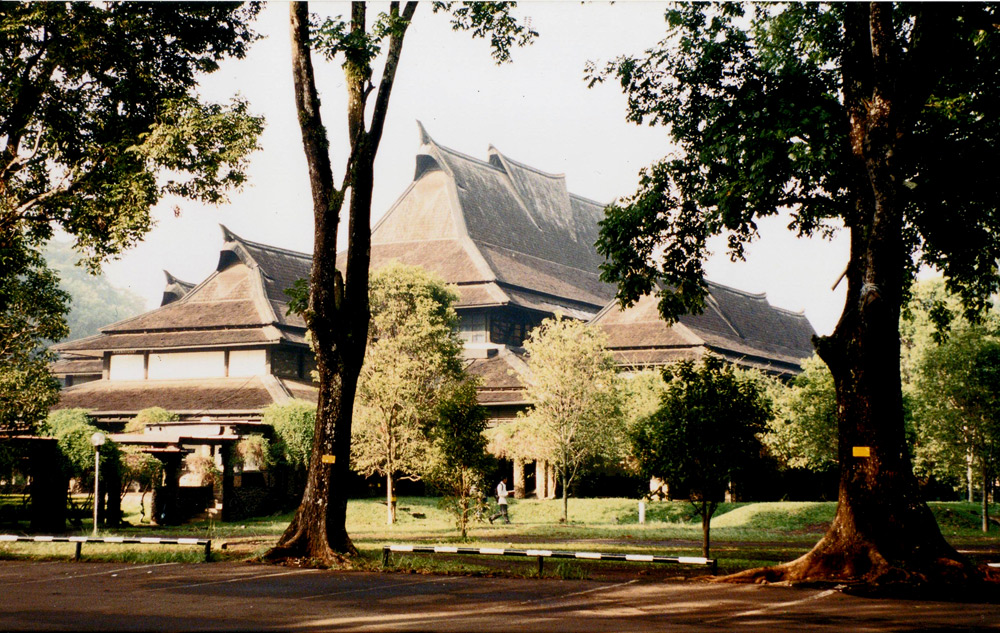
Bandung is home to numerous examples of Dutch colonial architecture; most notably the tropical Art Deco architectural style. Henri Maclaine-Pont was among the 1st Dutch architects to recognise the importance of combining each architectural style with local cultural traditions. He stressed that modern architecture should interact with local history and native elements. In 1920, Pont planned and designed buildings for the 1st technical university in the Dutch East Indies, Technische Hogeschool te Bandung, after which he was named as a professor in architecture at the university. A striking local Sundanese roof style is clearly seen adorning the top of the campus' ceremonial hall, embedded in his artwork.
In the same year, another Dutch architect J Gerber designed Gouverments Bedrijven in line with the colonial government plan to move the capital from Batavia to Bandung. The building is an example of a harmonious mixture between West and East architectural styles, particularly the Italian Renaissance style of arch structures in the west wing and Thailand's pagoda-like structures in the middle section. The building is known as Gedung Sate, named after the distinguished small satay-shaped structure on the roof, and is today used as the head office of West Java provincial government and West Java's house of representative.
The modern and native architectural blending was followed by several Dutch architects that have shaped the city landmarks. In the 1930s, Bandung was known also as the city of architecture laboratory because of the many Dutch architects who experimented with new architectural designs. Albert Aalbers added the expressionist architecture style to the Art Deco by designing the DENIS bank and renovated the Savoy Homann Hotel (1939). C.P.W. Schoemaker was one of architects who strongly added native elements in his artworks, including the Villa Isola (1932), Hotel Preanger (1929), the regional military headquarter (1918), Gedung Merdeka (1921) and ITB Rectorate Building (1925).
Bandung is a popular weekend destination of residents of Jakarta. The cooler climate of the highland plantation area, the varieties of food, the cheaper fashion shops located in factory outlets and distros, golf courses, and the zoo, are some of the attractions of the city. Bandung is also a popular shopping destination for the good value of its textile and fashion products among Malaysians and Singaporeans.
In the 1990s, local designers opened denim clothing stores along Cihampelas Street which transformed into a "jeans street". The city attracts people from other big cities to buy local fashion wears, as they are cheaper than branded items. Beside at Cihampelas Street, many factory outlets also opened at Riau Street, Setiabudi Street, and Djuanda Street. Textile factories on the outskirts of Bandung have opened factory outlets on site selling what is marketed as sisa export (rejected or over-produced export quality items). Bandung Supermal, Bandung Indah Plaza, Ciwalk (abbreviation of Cihampelas Walk) and Paris van Java are popular shopping centres in Bandung.
Bandung is the home town of the Persib Bandung football team. Another team, Persikab, is based in the neighbouring town of Soreang, the capital city of Bandung Regency and Pelita Jaya Jawa Barat. It shares its home base stadium with Persikab at Si Jalak Harupat stadium in Soreang and Pro Duta. Persib Bandung's home base stadium is Siliwangi Stadium. Other popular sports in Bandung include badminton. The roads leading up to Lembang and Dago are popular routes for mountain cycling during the weekend. In the hillside around Bandung, there are several golf courses.
Bandung can be accessed through highways from Jakarta. An intercity toll highway called Cipularang toll road, connecting Jakarta, Karawang, Purwakarta, Padalarang and Bandung, has recently been completed in May 2005. It is currently the fastest way to go to Bandung from the capital. Driving time is about 1.5 hours on average. There are 3 other options: the Puncak route, Purwakarta route (Jakarta-Cikampek-Purwakarta-Cikalong Wetan-Padalarang-Cimahi-Bandung) and the Subang route (Jakarta-Cikampek-Subang-Lembang-Bandung). From eastern part of the cities (Cirebon, Tasikmalaya and Central Java province), Bandung can be accessed through the main provincial road. Indonesian National Route 3 links Bandung towards Cilegon and Ketapang (Banyuwangi).
Bandung Husein Sastranegara International Airport serves direct domestic flights to Batam, Pekanbaru, Medan, Bandar Lampung, Surabaya, Yogyakarta, Denpasar, Semarang, Banjarmasin, Makassar, and also international services from Kuala Lumpur and Singapore. The airport is located nearby the Dirgantara aerospace complex and Dirgantara Fairground.
Bandung has two large railway stations, i.e. Bandung and Kiaracondong Stations. Other smaller stations are Cimindi, Andir, Ciroyom, Cikudapateuh, and Gedebage Stations. Railway connects Bandung to Cianjur, Jakarta, Purwakarta, Bekasi, Karawang and Cikampek to the west, and Surabaya, Yogyakarta and Solo to the east. It is also the major means of transportation for people living in suburb areas of Cimahi, Padalarang, Rancaekek, Cicalengka and Cileunyi. In 2012 Bandung Commuter Train phase-1 will be built to connect Padalarang, Cimahi, Bandung and Cicalengka. 13 Trans Metro Bandung corridors will serve as feeders. The phase-2 will connect Cicalengka to Jatinangor.
Trans Metro Bandung along Soekarno-Hatta street will be finished on August 2011 with cost of Rp13.1 billion ($1.54 million). Additional 30 buses will join the current operation of 10 buses, after all shelters have been finished.
Since 21 June 2011 Damri operator has launched 2 buses with route Cibiru-Kebon Kelapa vice versa special for women passengers only with women drivers. It accommodated the certain religion needs.
In 5 August 2011 Jusuf Kalla has announced that he would like to build a monorail in Bandung with value about Rp.4 trillion.
As of April 2012, the cable car project 'Bandung Skybridge' to connect Pasteur to Sabuga is at 90 percent of completion awaiting legal authorisation to operate. When approved, it will be operational within a year.
There are hundreds of public and private schools in Bandung. Like in other Indonesian cities, Bandung has several state-funded and administered State Junior High Schools and State High Schools (SMA Negeri). At least sixteen universities â€" three of which are state-owned â€" and 45 professional schools are scattered across the city. Education from social sciences, technology until tourism education can be found in one of those universities.

Related Sites for Bandung, Indonesia

Monday, September 9, 2013

Telkom Institute of Management, Bandung

Telkom Institute of Management

Telkom Institute of Management

Institut Manajemen Telkom English: Telkom Institute of Management was founded with the name Master in Business Administration (MBA) in Bandung, as the Graduate School.
At the beginning of its establishment, the Institute of Telkom Management fully adopted the Asian Institute of Management Philippines schooling system. MBA Bandung is the organizer of the 1st MBA program in West Java.
The organization and management of institutions were supervised by three professionals from AIM: one dean, one senior professor (Prof. Rafael J. Azanza), and one director (Emmy De Vera). The three introduced and implemented the AIM schooling system from 1990 to 1995. They came to IM Telkom to teach a team-teaching approach with the internal faculty and discuss the better management of educational institutions.
The application of schooling system at Telkom IM was successful - with the IPPM, IPMI, and Prasetya Mulya, it was listed as the four best business schools of the SWA in 1992, ahead of the public universities like UI, ITB, etc.

Related Sites for Telkom Institute of Management

Maranatha Christian University, Bandung

Maranatha Christian University

Maranatha Christian University


Maranatha Christian University was founded on September 11, 1965 by the Christian scientific community in Bandung with the support of the Indonesia Christian Church and Pasundan Christian Church by the effort of the medical students of the Immanuel Christian Indonesian University. The university used to include only two faculties which were the Faculty of Medicine and the Faculty of Psychology.
The course content is to attain the degree of Medical Bachelor. Students must attend lectures and do practical work in the pre medical, pre clinical, para clinical and the clinical fields. To be recognized as a general practitioner, students must train in the teaching hospital.
The medical bachelor's degree curriculum takes four years, while the profession degree requires another two years (49 credits over four semesters). Because of the organization of curriculum standards (called KIPDI) the 2006 admission of medical students have to carry out the competence based curriculum, which takes three years, while the professional degree requires another two years.
Immanuel Hospital is the prime teaching hospital. Immanuel has a polyclinic in each of the departments, plus a diagnostic center equipped with medical instruments used in ultrasonography, endoscopy, bronchoscopy, fuoroscopy, CT-scanning, lapparoscopic surgery and others.
There are other hospitals that are used as satellite hospitals such as Santo Yusuf Hospital, Doctor Salamun Hospital, Doctor Rotinsulu Lungs Hospital, Cisarua Mental Hospital, and also Cigugur Region State Hospital.
To earn the degree of Bachelor of Psychology, a student must complete 148 credits, which include writing a thesis. Subjects in the curriculum include psychology, psychodiagnostics, philosophy, psychotherapy, and research methodology.
If students wish to continue and become practicing-psychologists, they must take Master of Psychology. In this post-bachelor programme, students are trained to work in work settings such as general hospitals, mental hospitals, companies and educational institutions. Satisfactory completion of the post bachelor programme will bestow students with a qualification as practicing psychologists.
The Faculty of Psychology has formed partnership with public services such as the Pengembangan Potensi Anak and other government and private firms.
To gain the bachelor's degree a student must attend and carry out practical work for eight semesters or four years amounting to 148 credits.

Related Sites for Maranatha Christian University

Sunday, September 8, 2013

Bandung Institute of Technology, Coeducational Research University in Bandung, Indonesia

Bandung Institute of Technology

Bandung Institute of Technology
The Bandung Institute of Technology or Institute of Technology, Bandung is a state, coeducational research university located in Bandung, Indonesia. Established in 1920, ITB is the oldest technology-oriented university in Indonesia.
ITB was considered the top choice among Indonesia's high school students in 2006 and has been credited as one of the most "prestigious" universities in Indonesia, together with University of Indonesia and Gadjah Mada University.
Bandung Institute of TechnologyThe university cultivates professional and social activities by supporting its students' unions, the student government councils that exist in every department. Each students' union has its own distinctly designed jacket that, among other traditions, serves as part of its member identity. There are also a number of student activity units/clubs supporting ITB student interests in rounding out their educational experience. It isn't uncommon that the students and alumni are identified by the clubs to which they belong at ITB, in addition to their class year and major.
The university is a member of LAOTSE, an international network of leading universities in Europe and Asia exchanging students and senior scholars.
ITB's march "Mars ITB" and hymn "Hymne ITB" were arranged by a former professor, Prof. Dr. Sudjoko Danoesoebrata.
Institut Teknologi Bandung, was founded on March 2, 1959. The present ITB main campus is the site of earlier engineering schools in Indonesia. Although these institutions of higher learning had their own individual characteristics and missions, they left influence on developments leading to the establishment of ITB.
In 1920, Technische Hogeschool was established in Bandung, which for a short time, in the middle forties, became Kogyo Daigaku. Not long after the birth of the Republic of Indonesia in 1945, the campus housed the Technical Faculty (including a Fine Arts Department) of Universitas Indonesia, with the head office in Jakarta. In the early fifties, Faculty of Mathematics and Natural Sciences, also part of Universitas Indonesia, was established on the campus.
In 1959, the present lnstitut Teknologi Bandung was founded by the Indonesian government as an institution of higher learning of science, technology, and fine arts, with a mission of education, research, and service to the community.
Government Decree No. 155/2000 pertaining to The Decision on ITB as Legal Enterprise has opened a new path for ITB to become autonomous. The status of autonomy implies a freedom for the institution to manage its own business in an effective and efficient way, and to be fully responsible for the planning and implementation of all program and activity, and the quality control for the attainment of its institutional objective. The institution has also freedom in deciding their measures and taking calculated risks in facing tight competition and intense pressures.
Bandung, with a population of approximately one and a half million, lies in the mountainous area of West Java, at an altitude of 770 meters. The ITB main campus, to the north of the town centre, and its other campuses, cover a total area of 770,000 square meters.
Bandung Institute of TechnologyITB traces its origin to de Technische Hoogeschool te Bandoeng established by the Dutch colonial administration to meet the needs of technical resources at its colony in the region now known as Indonesia. When the school opened its door for the 1st time on July 3, 1920, it had one department namely 'de Faculteit van Technische Wetenschap' (Faculty of Technical Science) with only one academic major of 'de afdeeling der Weg en Waterbouw' (the department of Road and Water resources engineering). Later ITB became part of the Faculty Engineering of the University of Indonesia (UI) in Jakarta after the Indonesian independence in 1945. On March 2, 1959 ITB was officially chartered as a separate academic entity by the government of Indonesia.
The ITB main campus, to the north of the downtown Bandung, and its other campuses, cover a total area of 770,000 square meters.
Students and faculty housing, and administrative headquarters aren't on the main campus but are within easy reach. Facilities on the campus include book shops, a post office, student cafeteria, and medical clinic.
In addition to lecture rooms, laboratories, workshops and studios, ITB has an art gallery, sports facilities and a student activities' center. Also near the campus is the Salman Mosque for worship and religious activities of the ITB Muslim community. For implementation of academic and research activities there are seven academic support facilities, namely, the Central Library on campus, Sports Center, Language Center, and the Bosscha Observatory (a facility of the Department of Astronomy) in Lembang, 11 kilometers to the north of Bandung.
Several national, regional, and global surveys have been conducted to assess the quality of universities. ITB is among the 1st choices of college applicants to enter higher education. In a 1991 survey, the top 200 high school students in the national entrance examination indicated ITB as their 1st choice.
According to 4icu, an academic ranking method based on the popularity level of academic institutions in the World Wide Web, with total samples of more than 9200 institutions in 2010 by, ITB was ranked 30th in the world, far above other Indonesian universities like the Gadjah Mada University and the University of Indonesia (685), surpassing the leading university in Asia, such as Tokyo University (91) - MIT is at the 1st place of 4icu survey. THE-QS, a UK-based University ranking survey, ranked ITB 80th in the field of Engineering and IT in the world, the only university in Indonesia within the top 100 in its field. The 1st rank in the field was MIT. ITB is considered to have the highest selectivity in the field of science and engineering in the SNMPTN (nationwide state university entrance test) in 2009 from 422,159 examinees competing for its limited 2,000 seats. The passing grades required to enter its favorite faculties i.e., the School of Electrical Engineering and Informatics, the Faculty of Industrial Technology, and the Faculty of Mining and Petroleum Engineering are the highest among all faculties and majors in the SNMPTN (nationwide state university entrance test) even compared to medical faculties in other prestigious universities. Its business school, School of Business and Management is considered as the most prestigious, and most expensive also, business school in Indonesia and regarded as the best business school in Indonesia by eduniversal ranking and SWA Magazine, the most popular business magazine in Indonesia.
According to ITB rector, ITB will build an eight-story mining research center for both national and international research such as research on oil reservoirs, production optimization, geological exploitation and coal exploitation development worth Rp110 billion.

Related Sites for Bandung Institute of Technology

Saturday, September 7, 2013

Padjadjaran University : An institution of higher learning located in Bandung

Padjadjaran University

Padjadjaran University
Universitas Padjadjaran is an institution of higher learning located in Bandung, which is the provincial capital of West Java, Indonesia. UNPAD was established on 11th of September 1957, and officially opened by the President of Republic Indonesia Soekarno on the 24th of September 1957.
When established, the university had four departments: Law, Economics, Medicine, and Mathematics and Natural Sciences. Now it has developed into 16 faculties and several postgraduate programmes, 44 undergraduate programmes, two specialist programmes, nine doctorate programmes (Strata 3/S3), 19 Master's degree programmes (Strata 2/S2), five profession programmes, one four-year diploma program (D4), and 32 three-year diploma programs (D3).
Padjadjaran UniversityInitially established in Bandung, almost all undergraduate departments have been relocated to Jatinangor, a town near Sumedang, except for the departments of Law and Economics. Postgraduate departments still have their teaching facilities in Bandung.
For a time, Semaun was onthe economics faculty.
Each tutorial room has
faculty has tutorial rooms at A3
multimedia facilities. The
and A5.
The faculty has the main library at Jatinangor campus and libraries at each department of the faculty as well as the library at Hasan Sadikin Hospital.
The main library in A3 has 31000 holdings. Besides those, the library has electronics journals which provides 300 titles.
The library has air-conditioned rooms, reading rooms, computer facilities connected to the internet to access electronic journal (e-library).
The faculty has student
built in 2006.
dormitories. The 1st dormitory was
-
Previously the dormitories were accommodation facilities for all international students during their 1st year of study.
In September 2011, the university announced its intention to build a shopping centre and a three storey hotel in Jl. Dago with the profits used to finance the university.

Related Sites for Padjadjaran University