Friday, December 19, 2014

Kebun Cengkeh (Clove Garden) Paintings by Affandi (famous painter from Indonesia)

Painter: Affandi
Year: 1981
Title : Kebun Cengkeh (Clove Garden)
Media: Oil on Canvas

A high-class art works of the painter maestro Affandi, depicts a clove plantation landscapes, hilly plantation areas unspoiled what it seems painted from nature, to liven up the painting, dihadirkanya human figures as a supporting object, but is the essence of painting, which show an activity that blends with the natural life. Expression typical scratches Affandi unique look, which makes it a special painting.

As with most Affandi who always put the Sun as part of the main object, but in this painting, the unique placement of the sun visible, as if the artist takes the perspective is reversed position of the sun, so the sun does not appear in the painting behind the hill, but appeared over the hill and cover hill, this uniqueness may be owned only by Affandi, as the way he is in the air standpoint expression, where the quality of the imagination as a painter renowned maestro.

Saturday, December 13, 2014

Baksa Kembang : Tradisional dance from South Kalimantan

Baksa Kembang (Flower) dance comes from the Banjar, South Kalimantan as a dance to welcome guests. This dance is usually danced by women, both single and can also danced by several female dancers. Beginning approximately the 15th century BC, a prince named Suria Ganga dynasty in Dipa and Daha kingdom on the island of Borneo has a girlfriend named daughter Kuripan. One other events in time is when the daughter Kuripan give a red lotus flower to the prince. That event was the forerunner born Baksa dance Fireworks in Banjar South Kalimantan province.

According Yurliani Johansyad, classical dance expert Banjar. Dance Flower Baksa there since before the reign of Sultan Suriansyah first king kingdom of Banjar. This dance was created one period to the other Baksa dance,  Baksa Dadap, Baksa Lilin, Baksa Panah dan Baksa Tameng from Hindu era before Islam came.

Baksa Kembang is dance to welcome the guests of honor or royal relatives. This tradisional dance is also performed by the general public in weddings or custom events. Originally this dance is a dance that was in the kingdom. At one time, the kingdom of open access to the public realm so that the culture of the kingdom brought to the general public. Currently, dance Baksa Flower still used events to welcome the guests were honored even though there are many dancers dance Flower Baksa not understand the meaning and value of the Flower Dance Baksa. Baksa has a sense of softness. Baksa dance flower is in the form of softness host welcomes an honored guest. The welcome was done by dancers dance Baksa Flower provide flower arrangements to honored guests. The values are the transformation of love lovers Syrian prince with a princess Kuripan Ganga Dynasty.

Flower Baksa dance dancer must odd. In addition, the flower arrangements given to the guest of honor is a blend of flower arrangements roses and jasmine flower is called by local people Bogam.

Traditional Dance from West Java

West Java Is One Indonesian provinces in densely populated areas, the population density is due to the region of West Java has a strategic geographical location, not far from the capital, have the facilities and education centers, trade centers and has abundant natural resources, so that many residents outside the crowd come to West Java, other than just to gain knowledge, shop and take a holiday, but they also exist among deliberately try his fortune to live and settle in West Java. Famous West Java community with people who are friendly, polite and courteous and have high creativity. 

Traditional Dance from West Java

One testament to the creativity that was built by the people of West Java is the creation of traditional dances from West Java. Here are some of the traditional dances of West Java:
1. Jaipongan
2. Tap Tilu
3. Digenjring Bonyok
4. Sipytri Sintren
5. Mask Cisalak
6. Horse Renggong
7. Nail Jajar
8. Queen Graeni
9. Ronggeng
10. Mask Hero Member Priangan


That's some traditional dance from West Java, in fact there are many dances of West Java still have not mentioned the name and yet to be formalized as a traditional dance from West Java.

Serimpi dance from Yogyakarta

Serimpi dance is a classic dance of Jogjakrta are always performed by four dancers because serimpi word means four world symbolizing the four elements, namely: fire, wind, air and earth (ground). Serimpi dance showed by four daughters with Batak role name, Gulu, Dhada and Buncit 4 pillars that symbolize the pavilion. Dance serimpi associated with IMPI word or dream for graceful dance movement makes the audience feel on dreamland.
Serimpi dance from Yogyakarta

That said, history Serimpi dance originated from the period between 1613-1646 reign of Sultan Agung of Mataram Kingdom. In 1775 the Mataram kingdom broke into the Sultanate of Yogyakarta and Surakarta Sultanate and the impact on the dance serimpi. In the Sultanate of Yogyakarta classified into Serimpi Babul screen, Serimpi Dhempel, Serimpi Genjung. While in the Sultanate of Surakarta classified into Serimpi Anglir Overcast and Serimpi Bondan.


Although it has been created for a long time, this new dance known Serimpi many audiences since the 1970s because it was considered sacred dance and only staged in the palace for the ritual state. Serimpi live in the palace of Yogyakarta and an art considered heirloom adhiluhung and Kraton.


Dance Clothes Serimpi experiencing growth. If at first like princess bride clothes Kraton Yogyakarta style with dodotan and bight bokornya as decorative motifs head, then later switch to a sleeveless shirt with frayed feather headdress cassowary and fried bun decorated with flowers. Characteristics of the dancers Serimpi is dagger tucked in the front cross to the left. The use of a dagger on Serimpi dance is due to be used in the battle scene, which is a characteristic motif depicting Dance Serimpi dispute between two opposites between good and evil, between right and wrong, between the human mind and human passion.

Monday, December 8, 2014

Basic Motion Concepts of Traditional Indonesian Dance

We've all watched a dance performance, either directly or through electronic media such as television. Of the show, we can observe a variety of dance is done. Have you discussed this observation? Of course of you have a different understanding because you observe the dance is different from the others. Each dance has a different motion but has a similarity that has the power, space and time.

Indonesia has a rich diversity of dance that is different between tribes. Of course we can see the characteristics of each ethnic dance different from each other. For instance motion on Malay and Sundanese dance performed always coincide with the beat (on the beat) with power being. Javanese dance tends to be done in slow motion and force are. Balinese dance performed by the energy and time varying motion. These differences are caused by the energy released, space, and time varying movement between each dance.


Basic Motion Concepts of Traditional Indonesian Dance
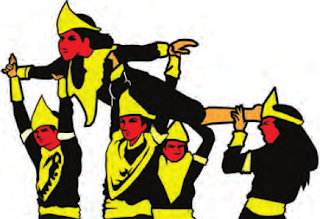
Fig 1. Motion with strong force element
Consider dance in Figure 1, the figure shows that dance movement has a strong element of force, motion carried rampak by the dancer, a dancer who was appointed by some other dancers such as lifting a heavy object, which has a strong sense of power.

Power used by dancers to support his friend certainly greater than the force raised dancer. Manpower strength to withstand heavy loads concentrated on his hands. Similarly, in every exercise, of course, takes power. Use in power have a strong intensity, moderate and weak depending on how the use or distribution of such power.


Basic Motion Concepts of Traditional Indonesian Dance
Fig 2. Pose gestures wide open

Consider dance shown in Figure 2. Pose motion showed broad visible space between the body and arms are done in groups of dancers. All the dancers perform the same space. Motion in space can be done alone, in pairs or groups. In addition to requiring power and space, the motion also requires time. Any movement takes time. Differences fast or slow motion associated with the tempo. So tempo is: fast or slow motion carried.

Basic Motion Concepts of Traditional Indonesian Dance
Fig 3. Motion Respect
The function of the dance tempo is to provide a dynamic impression that dance becomes enjoyable. Consider Figure 3, respectful motion dancer poses one another with different dancers. A dancer who performed with a faster tempo, while the next dancers performed with a slow tempo, the tempo setting is done differently with the same movement.

Traditional Theatre in Indonesia

Indonesia is a country with diverse cultures, and tradition plays a significant role in shaping the country's identity. Traditional arts such as dance, music, theater, and crafts are integral to Indonesian culture, and they have been passed down from generation to generation for centuries. These traditions are often deeply rooted in the beliefs and customs of the local communities, and they reflect the country's rich cultural heritage.

Traditional arts have evolved over time, and many contemporary artists have been incorporating modern elements into their work to appeal to a broader audience. For example, traditional dance forms like the Javanese court dance, which was once performed exclusively for the royalty, have been adapted for public performances and competitions. Similarly, traditional music forms like Gamelan and Keroncong have been infused with modern instruments and styles to make them more accessible to younger generations.

In recent years, there has been a growing interest in traditional theater in Indonesia, particularly in the form of puppetry. Wayang Kulit, or shadow puppetry, is one of the most popular traditional theater forms in Indonesia, and it has been recognized as a Masterpiece of Oral and Intangible Heritage of Humanity by UNESCO. Contemporary puppeteers are experimenting with new techniques and themes, using the traditional art form to comment on modern social and political issues.

Despite the modernization of traditional arts, many Indonesians continue to hold on to their traditional values and customs. Traditional ceremonies, such as weddings, funerals, and religious festivals, are still celebrated across the country, and they often involve intricate rituals and performances. These ceremonies play an essential role in preserving and passing down cultural traditions from one generation to the next.

Some traditional Indonesian theater is as follows:

1. Lenong (Traditional Indonesian Theatre of Batavia)

There are two forms of Lenong;
(1) Denes
Denes Lenong spectacle tells of kings and princes in the kingdom, now it is rarely encountered, since almost no successors.

(2) Lenong Preman
Performances of "Lenong Preman" tells about ordinary people, as we know it today, in the beginning, Lenong Preman played all night. Since the days of growing and demand situation, the changes occur.

Along with the launch of TIM (Taman Ismail Marzuki), lenong that had just played in the villages, by SM. Ardan, brought to TIM, but when the show was shortened by one or two and a half hours.

Another traditional Betawi theater include Betawi Mask (Topeng Betawi), Mask Blantek (Topeng Blantek) and Jipeng (Jinong).

•  Lenong using musical instrument "Gambang Kromong"
•  Topeng Betawi using musical instruments "Tabuhan Topeng Akar"
•  Topeng Blantek using musical instruments "Tabuhan Rebana Biang"
•  Jipeng or Jinong using musical instruments "Tanjidor"

Lenong performances using Betawi. Historically, Lenong under the influence of the theater Nobility.

2. Longser (traditional Indonesian Theatre in West Java)

Longser is a traditional theater art form in Indonesia that originated in the 1920s and gained widespread popularity until the 1960s. The name Longser is derived from the words "Melong" meaning seeing and "seredet" meaning intrigued. This term refers to the emotional impact that a Longser show can have on its audience. The show is designed to captivate the audience with its simple, witty, and entertaining performances.

Longser shows can be performed anywhere, as they do not require elaborate decorations. The seating arrangement is circular, which allows the audience to be close to the performers and to have a clear view of the show. Longser performances usually consist of a group of actors, dancers, and musicians who work together to tell a story through movement, music, and dialogue.

Longser shows often feature comedic and satirical elements, with actors portraying exaggerated characters and situations. The characters in Longser shows are often based on archetypes of Indonesian society, such as the poor farmer, the wealthy merchant, or the cunning thief. Some of the most famous Longser characters include Ateng Japar, Bang Tawes, Bang Tilil, Bang Soang, and others.

Despite its declining popularity in recent years, Longser remains an important part of Indonesian cultural heritage. Many efforts have been made to preserve and promote Longser, such as holding festivals and competitions, documenting performances, and providing training and support for performers. Longser continues to be an entertaining and engaging form of traditional theater, beloved by audiences across Indonesia.

3. Ketoprak (Indonesian Traditional Theatre in Central Java)

Ketoprak is a form of traditional theater in Indonesia that originated from the Javanese culture, specifically from Central Java. It is believed to have been first staged around 1909 and was initially called Ketoprak Dimples. At first, Ketoprak was just a game played by villagers to entertain themselves by using a mortar that sounded at full moon, which was called gejogan entertainment. However, Ketoprak later evolved to become a complete and popular traditional theater spectacle that includes music, drums, flutes, singing, and drama that depicts the lives of people in the countryside.

Ketoprak has become an important aspect of Javanese culture and is often performed during cultural events and festivals. It usually tells a story about the struggle of the common people against the power of the elites, with elements of comedy and satire added in. The stories often feature Javanese mythology, legends, and history. The characters are usually played by male actors, although female roles are also present in some Ketoprak performances.

The music and songs in Ketoprak are an essential part of the performance. They are usually played by a gamelan orchestra, consisting of traditional Javanese instruments such as gongs, xylophones, and drums. The music and songs are meant to enhance the emotional impact of the story being told and to convey the feelings of the characters.

Ketoprak has undergone various changes and developments throughout its history. In modern times, it has been influenced by Western theater and cinema, leading to the incorporation of new elements such as lighting, costumes, and set designs. Despite these changes, Ketoprak remains an important part of Javanese culture, and efforts are being made to preserve and promote this traditional art form.

4. Ludruk (traditional Indonesian Theatre in East Java)

Ludruk is a type of traditional theater that originated from Jombang, a city known as the city of students in Indonesia. It is performed using the East Javanese dialect of the Javanese language. Ludruk has become popular over time and spread to other areas, including the western region of the Madiun and Kediri residency, and to Central Java.

One of the unique aspects of Ludruk is that all the roles are played by men. The performances are characterized by the use of humor, satire, and parikan, which are humorous Javanese verses. Ludruk's stories often depict the daily struggles and challenges faced by ordinary people in society, and their fight against oppression.

The influence of parikan in Ludruk theater is significant, as it adds humor and light-heartedness to the performances. An example of a famous parikan sung during the Japanese colonial era by Cak Durasim, which depicted the struggle against the kempetei, the Japanese military police. The parikan goes like this: "Pagupon Omahe doro melok Nipon added soro," which means "Our house is small, but the Japanese (kempetei) is even smaller."

Despite being a traditional form of theater, Ludruk remains popular and relevant in modern-day Indonesia. It has been performed in various festivals and events, showcasing the country's rich cultural heritage.

5. Arja (traditional Indonesian Theatre in Bali)

Arja is a traditional Balinese theater that has been popular for many years in Bali. It is a unique form of traditional theater that is known for its emphasis on dancing and singing. Originally, Arja was performed by men, but over time, women have taken on a more prominent role in the art form, due to its emphasis on dance.

The performances in Arja are generally based on the Gambuh story, which is a story of contrast. However, over time, other stories from the Ramayana and Mahabharata have also been incorporated into the performances. The characters that appear in Arja include Melung (Inye, Lean), a servant girl, Galuh or Sari, Limbur or Prameswari, the king and princess, paramedics, and others.

The dancers in Arja performances are highly trained and skilled. They are able to convey a range of emotions through their movements, and their movements are often accompanied by the sounds of gamelan music. The performances are elaborate, colorful, and visually stunning, with elaborate costumes and makeup.

Arja is an important part of Balinese culture and is often performed during temple ceremonies and other important events. The performances serve as a way to connect people to their culture and history, and to preserve traditional forms of expression. The popularity of Arja has led to the establishment of Arja schools in Bali, where young people can learn the art form and continue its legacy for future generations.

6. Kemidi Rudat (traditional Indonesian Theater in NTT)

Kemidi Rudat is a traditional theater performance that is popular in West Nusa Tenggara, Indonesia. This form of theater is similar to other traditional theater forms found in Indonesia. The Kemidi Rudat spectacle is a combination of drama, dance, and singing.

The word "Rudat" means marching, and it is said that the origin of the word comes from the influence of the Malay culture. The music used in Kemidi Rudat performances has a Malay influence and is played using drums, tambourines, violins, and other instruments. The story of Kemidi Rudat is based on old Malay stories, and the dialogue is spoken in the Malay language.

Kemidi Rudat performances are known for their colorful costumes and lively dance movements. The performers wear traditional Malay clothing, such as sarongs and kebayas. The dance movements are accompanied by the rhythm of the music and are meant to tell the story of the performance.

Kemidi Rudat is an important cultural tradition in West Nusa Tenggara, and it is often performed during special events and celebrations. The performance is a symbol of the region's rich cultural heritage and is an important part of its identity.

7. Kondobuleng (traditional Indonesian Theatre in  Makassar)

Kondobuleng is a traditional theater form originating from Makassar, which is part of the Bugis culture in Indonesia. The name "Kondobuleng" is derived from the words "condo" which means stork and "buleng" which means white, hence "Kondobuleng" means white stork. The spectacle of Kondobuleng is filled with symbolic meaning and is played spontaneously, just like any other traditional theater. The symbolic story revolves around humans and storks and is presented with a combination of jokes, motion, and stylization.

What sets Kondobuleng apart from other traditional theaters is the absence of a boundary between the player character and the property that is used in a particular scene. In other words, the actors play multiple roles, including inanimate objects. For example, they can play the role of a boat crossing the ocean while also portraying characters on board the boat. This unique approach to acting creates an immersive experience for the audience and makes the performance more engaging.

Kondobuleng is not only a form of entertainment, but it also plays an important role in preserving the Bugis culture. The traditional theater form is passed down from generation to generation and is seen as a way to keep the Bugis culture and traditions alive. Today, Kondobuleng is still performed in Makassar and other parts of Indonesia, showcasing the rich cultural heritage of the Bugis people.

8. Dulmuluk (traditional Indonesian Theatre in Palembang)

Dulmuluk is a traditional theater performance that originated in Palembang, South Sumatra, Indonesia. It is a type of theatrical performance that tells stories from the Abdoel Moeloek saga, with the main character named Dulmuluk, hence the name of the theater. Dulmuluk is also known as the Indra Duke Theatre.

The performance of Dulmuluk involves a combination of drama, dance, and singing as a means of storytelling. Music is also an integral part of the spectacle, as the actors sing their dialogue. The music is played using traditional instruments such as the gong, rebana, and gendang.

The Dulmuluk spectacle is well-known for its use of humor and jokes, making it a lively and entertaining performance. The use of dance, singing, and drama create a dynamic and engaging performance, which draws in the audience and keeps them captivated throughout.

Dulmuluk has been passed down through generations and has become an important part of Palembang's cultural heritage. It is often performed during traditional ceremonies, such as weddings and religious festivals, and is also featured in cultural festivals and events. The Dulmuluk spectacle has become an important symbol of Palembang's rich cultural history and identity, and continues to be celebrated and performed by local communities today.


9. Randai (traditional Indonesian Theatre in Minangkabau)
Randai is a traditional theater performance that originated from the Minangkabau culture of West Sumatra, Indonesia. The term "Randai" is derived from the word "randah", which means to invite or summon. The Randai theater performance has its roots in oral literature called "kaba", which means "story". The kaba is in the form of couplets and quatrains sung to the accompaniment of various musical instruments, including the rabab, saluang, bansi, and tambourine.

The Randai performance takes place in a circular pattern, based on the movements of contrasting dance and martial arts movements, which are called "wave". The stories that are told in the Randai spectacle are often oral stories in the form of legends and fairy tales that are popular in the community. The performance is characterized by the integration of music, singing, dance, drama, and martial arts.

The Randai performance is usually exhibited in the context of traditional ceremonies or festivals. It is a unique art form that is often used to preserve cultural heritage and promote cultural identity. The Randai theater is also used as a tool for social and political commentary, as it can address issues that are important to the community.

The martial arts movements in Randai are not just for show, but they also have practical applications. The movements are derived from traditional Minangkabau martial arts, which are used for self-defense and combat. The martial arts movements in Randai are performed by the dancers in synchronization with the music, creating a mesmerizing visual spectacle.

Overall, Randai is a unique and fascinating art form that combines music, singing, dance, drama, and martial arts. It is an important cultural heritage of the Minangkabau people and a valuable contribution to the world of theater.


10.Makyong (traditional Indonesian theater in Riau)

Makyong is a traditional theater art form that originated from the Mantang island in Riau, Indonesia. It started as a dance and singing performance, but later evolved into storytelling, depicting legends and folk tales. The art form was highly regarded by nobles and sultans, and was often exhibited in palaces. The spectacle begins with a ceremony presided over by a panjak, who is responsible for all offerings given for salvation.

Humor, dance, singing, and music are the main components of a Makyong performance. What sets Makyong apart from other traditional theatrical performances is that it is predominantly played by women. If male performers do appear, they always wear masks, while the female performers do not. The stories of the play are based on oral literature in the form of fairy tales and legends that are popular in the community.

Makyong is a highly ritualistic art form that requires a lot of preparation and discipline. The performers must undergo rigorous training to perfect their movements and singing, and the costumes and makeup must be meticulously crafted to create a visually stunning experience for the audience. The music and instruments used in Makyong are also unique, consisting of traditional Malay instruments such as the gambus, rebab, and serunai.

In recent years, Makyong has seen a resurgence in popularity, thanks to efforts by cultural preservationists and the government to promote traditional art forms. Makyong festivals are now held annually in various regions of Indonesia, providing a platform for artists to showcase their skills and for audiences to experience the beauty and richness of Indonesian culture.

11.Mamanda (traditional Indonesian Theatre in Banjarmasin)

Traditional theater Mamanda is a cultural heritage from Banjarmasin, South Kalimantan. Its roots date back to 1897 when the Duke Malacca group arrived in Banjarmasin, bringing with them the story from the poem Abdoel Moeloek. Despite Banjar people being familiar with various traditional arts such as puppets, masks, Rudat, dancing, Hadrah, and Japin, the Duke group managed to carve out a special place in the society with their unique theatrical performances.

Over time, the group’s name changed to Badamuluk Duke and eventually evolved into Bamanda or Mamanda. The term Mamanda itself comes from two words, "mama" meaning "uncle" and "nda" meaning "honorable". Thus, Mamanda is translated to "Dear Uncle". The structure and characterization of Mamanda performances have remained relatively unchanged over the years, except for some minor modifications in terms of dressmaking, hairdressing, music, and artistic expression.

Mamanda performances typically involve a group of male actors who play different roles, ranging from the lead characters to supporting roles. The storyline often revolves around the themes of love, betrayal, and family conflicts, and the performances are usually accompanied by traditional music, dance, and singing. The actors in Mamanda theater use their voice, movement, and facial expressions to convey the emotions and messages of their characters.

Despite the popularity of modern entertainment, traditional theater Mamanda still holds a significant place in the cultural heritage of South Kalimantan. It serves as a reminder of the rich history and traditions of the region, as well as a means of passing down cultural values and beliefs to future generations.

Q&A : Traditional Theatre in Indonesia

What is a traditional theater?

A traditional theater is a form of performing arts that has been passed down through generations and has deep cultural roots in a particular region or country.

What does the most well known form of traditional theater in Indonesia consist of?

The most well known form of traditional theater in Indonesia is wayang kulit, a form of shadow puppetry.

What is a well known Indonesian theater popular?

Wayang kulit is a well-known and popular Indonesian traditional theater.

What are the elements of Indonesian theater?

The elements of Indonesian theater include music, dance, storytelling, and visual arts, often combined to create a rich and immersive theatrical experience.

What is a traditional theatre art of Indonesia?

Wayang kulit is a traditional theater art of Indonesia that involves shadow puppetry.

What is the traditional entertainment in Indonesia?

Traditional entertainment in Indonesia includes various forms of music, dance, puppetry, and theater.

What are the three traditional forms of theater?

The three traditional forms of theater are puppetry, dance drama, and masked theater.

Is wayang kulit a traditional theater form in Indonesia?

Yes, wayang kulit is a traditional theater form in Indonesia.

Is wayang kulit a traditional theater art of Indonesia?

Yes, wayang kulit is a traditional theater art of Indonesia that has a long history and cultural significance.

What is the most popular Indonesian traditional ensemble?

The most popular Indonesian traditional ensemble is the gamelan orchestra, which often accompanies wayang kulit performances.

What country is known for their traditional theater art form?

Many countries have their own traditional theater art forms, but some well-known examples include Japan's Noh theater, China's Beijing opera, and India's Kathakali.

What is one of the most famous forms of arts in Indonesia?

One of the most famous forms of arts in Indonesia is batik, a traditional textile art that involves dyeing fabric with intricate patterns.

What kind of theatre is wayang kulit?

Wayang kulit is a form of puppet theater that uses shadow puppets made of leather to tell stories.

What are the traditional types in wayang kulit?

The traditional types in wayang kulit include the heroes (pandawa), the villains (korawa), and various gods and goddesses from Hindu mythology.

Where did wayang kulit theatre originate?

Wayang kulit theater originated in Java, Indonesia, and has since spread to other parts of the country and Southeast Asia.

What is wayang puppet theater?

Wayang puppet theater is a traditional form of puppetry from Indonesia that involves using intricately designed puppets to tell stories from Hindu epics.

What instrument is wayang kulit theater?

The main instrument used in wayang kulit theater is the gamelan orchestra, which typically includes a variety of percussion and melodic instruments.

What are the main characters of the wayang kulit theater?

The main characters of the wayang kulit theater include the heroes (pandawa), the villains (korawa), and various gods and goddesses from Hindu mythology, such as Krishna, Arjuna, and Sita.

What is the function of wayang kulit as a theater form?

The function of wayang kulit as a theater form is to entertain, educate, and transmit cultural and moral values to the audience, while also serving as a form of ritual and spiritual expression.

What is the story of wayang kulit?

Wayang kulit tells a wide range of stories from Hindu epics, such as the Ramayana and Mahabharata, as well as local legends and folklore. These stories often feature themes of good vs. evil, heroism, and the triumph of virtue over vice.

Wednesday, November 5, 2014

X Factor Indonesia

X Factor Indonesia

X Factor Indonesia
The X Factor Indonesia is an Indonesian reality television music competition to find new singing talent; the winner of which receives a 1 billion rupiah including a recording contract with Sony Music Indonesia. Premiered on December 28, 2012 on RCTI, it is the 2nd franchise to be adapted in Southeast Asia after the Philippines.
X Factor IndonesiaAs part of the British The X Factor franchise, the show's format has numerous differences from rivals such as Indonesian Idol. The competition is open to both solo artists and groups and has no upper age limit. Each judge is assigned one of four categoriesâ€"boys between 15 and 25, girls between 15 and 25, individuals 26 and over, or groups. Throughout the live shows the judges act as mentors to their category, helping to decide song choices, styling and staging, while judging contestants from the other categories; they also compete to ensure that their act wins the competition, thus making them the winning judge.
The original judging panel was Ahmad Dhani, Rossa, Anggun, and Bebi Romeo, with Robby Purba as the host. There has been one winner of the show to date: Fatin Shidqia.
Although Indonesian Idol went on to become an enormous success and the number 1 show in Indonesia for seven consecutive seasons, the original UK version, Pop Idol didn't fare so well. Cowell, who was a judge on Pop Idol, wished to launch a show which he owned the rights to. Pop Idol's 1st series was massively successful, and while the 2nd series was also successful, the viewers figure for its finale dropped. Someâ€"including Pop Idol judge Pete Watermanâ€" considered Michelle McManus an unworthy winner. In 2004, Pop Idol was axed and ITV announced a new show created by former Pop Idol judge Simon Cowell, with no involvement from Idol creator Simon Fullerâ€"The X Factor. Its ratings were average in the 1st couple of series, but by the 6th series in 2009, ratings were hitting 10 million each week.
In March 2010, RCTI, the broadcaster of Indonesian Idol, signed the deal to launch the Indonesian version of The X Factor. Initially, X Factor Indonesia was planned as a replacement for Indonesian Idol in 2013, but due to the enormous success of the 7th season in 2012, RCTI and FremantleMedia decided to continue collaborating both the X Factor Indonesia and Indonesian Idol with each playing on alternate years. To repeat the success of 7th season of Indonesian Idol, Fabian Dharmawan from RCTI was appointed to be the Executive Producer for RCTI for the 1st season of the X Factor Indonesia, Head of Entertainment of FremantleMedia, Glenn Sims together with Virgita Ruchiman and Ken Irawati serving as Executive Producers for FremantleMedia Indonesia.
In August 2012, RCTI began airing short commercials for the program, which displayed the text "Coming Soon in Indonesia". A 2nd promo was shown during that night, featuring One Direction, Agnes Monica, Afgan, Iwan Fals, 3 Diva, Glenn Fredly, SM*SH, Ariel 'NOAH', Ayu Ting Ting, 7 Icons, Tria 'The Changcuters', and JKT48. This promo started speculation on who would be judges on the X Factor Indonesia.
X Factor premiered inIndonesia on December 28, 2012.
The show is primarily concerned with identifying singing talent, though appearance, personality, stage presence and dance routines are also an important element of many performances. Each judge is assigned one of four categories: "Girls", "Boys" (aged 15â€"25 males), "Over 26s" (solo acts aged 26 and over), or "Groups" (including duos; some of which may be formed from rejected soloists after the audition process). Through the live shows, the judges act as mentors to their category, helping to decide song choices, styling and staging, while judging contestants from other categories.
The show is open to solo artists and vocal groups aged 15 and above, with no upper age limit. The 1st set of auditions is held in front of the show's producers, which isn't televised. Only candidates who successfully pass the producers' auditions are invited to perform to the judges. The judges' auditions are held in front of a live audience and the acts sing over a backing track. In that case, at least three out of four judges have to tell "yes" for the auditionee to advance to the next round, otherwise they are sent home. In addition, there is an online audition too in which the auditionees can upload their performance on the X Factor Indonesia website and the get the vote from viewers on Youtube. An auditionee with the most voted video will get the chance to meet the judges and awarded cash prize.
A selection of the auditions in front of the judges â€" usually the best, the worst and the most bizarre â€" are broadcast over the 1st few weeks of the show.
The contestants selected at auditions are further refined through a series of performances at "bootcamp", and then at the "judges' home visits", until a small number eventually progress to the live finals. In the bootcamp, contestants will have to go through a series of challenges until the number of contestants were trimmed down to 26 and divided according to their categories. At the end of bootcamp, the producers will also reveal which category the judges will be mentoring. The judges then disband for the "judges' home visits" round, where they further reduce their acts on location at a residence with the help of a celebrity guest mentor.
The finals consist of a series of two gala live shows, with the 1st featuring the contestants' performances and the 2nd revealing the results of the public voting. Celebrity guest performers will be featured regularly.
The performance show occasionally begins with a group performance from the remaining contestants. The show is primarily concerned with identifying a potential pop star or star group, and singing talent, appearance, personality, stage presence and dance routines are all important elements of the contestants' performances. In the initial live shows, each act performs once in the 1st show in front of a studio audience and the judges, usually singing over a pre-recorded backing track. Dancers are also commonly featured. Acts occasionally accompany themselves on guitar or piano. Each live show has had a different theme; each contestant's song is chosen according to the theme. After each act has performed, the judges comment on their performance. Heated disagreements, usually involving judges defending their contestants against criticism, are a regular feature of the show. Once all the acts have appeared, the phone lines open and the viewing public vote on which act they want to keep. Once the number of contestants has been reduced to six, each act would perform twice in the performances show. This continues until only three acts remain. These acts go on to appear in the grand final which decides the overall winner by public vote.
The two acts polling the fewest votes are revealed. Both these acts have to perform again in a "final showdown", and the judges vote on which of the two to send home. They were able to pick new songs to perform in the "final showdown". Ties are possible as there are four judges voting on which of the two to send home. In the event of a tie the result goes to deadlock, and the act who came last in the public vote is sent home. The actual number of votes cast for each act isn't revealed, nor even the order. Once the number of contestants has been reduced to five, the act which polled the fewest votes is automatically eliminated from the competition.
The winner of the X Factor Indonesia is awarded a recording contract from Sony Music Indonesia, which would include investments worth 1 billion rupiah, which is claimed as the largest guaranteed prize in Indonesian television history. Several cash rewards from the sponsors, including a new car, is also awarded for the grand finalists in the 1st season.
To date, one season has
summarized below.
been broadcast, as
-
Many people were rumored to be in the running to join the judging panel, including Indra Lesmana, Titi DJ, Maia Estianty, Vina Panduwinata, Tompi, Anang Hermansyah, Sherina Munaf, Agnes Monica, Ruth Sahanaya, and Iwan Fals. Eventually, Dewa 19-frontman, musician, songwriter, and record producer Ahmad Dhani, singer, musician, and songwriter Bebi Romeo, pop diva Rossa, and International Diva Anggun were confirmed to join this show as judges. Pop sensational singer Mulan Jameela filled in for Anggun at the auditions while Anggun was performing in her Europe Live Tour Concert. Numerous people were speculated to host the series, including VJ Boy William and Daniel Mananta, host of Indonesian Idol. On November 23, 2012, ex-VJ Robby Purba was announced as host of the show.
In each season, each judge is allocated a category to mentor and chooses a small number of acts to progress to the live shows. This table shows, for each season, which category each judge was allocated and which acts he or she put through to the live shows.
In week six of season one, Ahmad Dhani and Rossa opted to send home Alex Rudiart in favor of Gede Bagus, causing the elimination of Alex Rudiart. This decision resulted in large amount of criticisms and outrages from the public, who claimed the decision as unfair. As a result, a lot of social media reactions begin to appear including several motion to boycott the show.
On September 29, 2012, RCTI, SYCOtv and FremantleMedia Asia announced that Cross Mobile will be the official sponsor of the X Factor Indonesia. The sponsorship includes an extensive multi-platform on and off-air marketing partnership. On December 26, Kopi ABC was announced as the 2nd official sponsor of the show. Kopi ABC's sponsorship will also include an extensive multi-platform on and off-air marketing partnership. Indosat Mentari, which is 100% owned by MNC Media, was confirmed as the 3rd official sponsor on December 28. Indosat Mentari's sponsorship of the X Factor Indonesia will also include an extensive multi-platform on and off-air marketing partnership between Indosat and MNC Sky Vision. Oriflame also sponsored the show as the official make-up sponsor. Procter & Gamble using it as a platform to promote its Pantene, Olay and Downy brands.

Related Sites for X Factor Indonesia