Sunday, July 21, 2013

Java Man : Fossils Discovered in 1891 at Java, Indonesia

Java Man


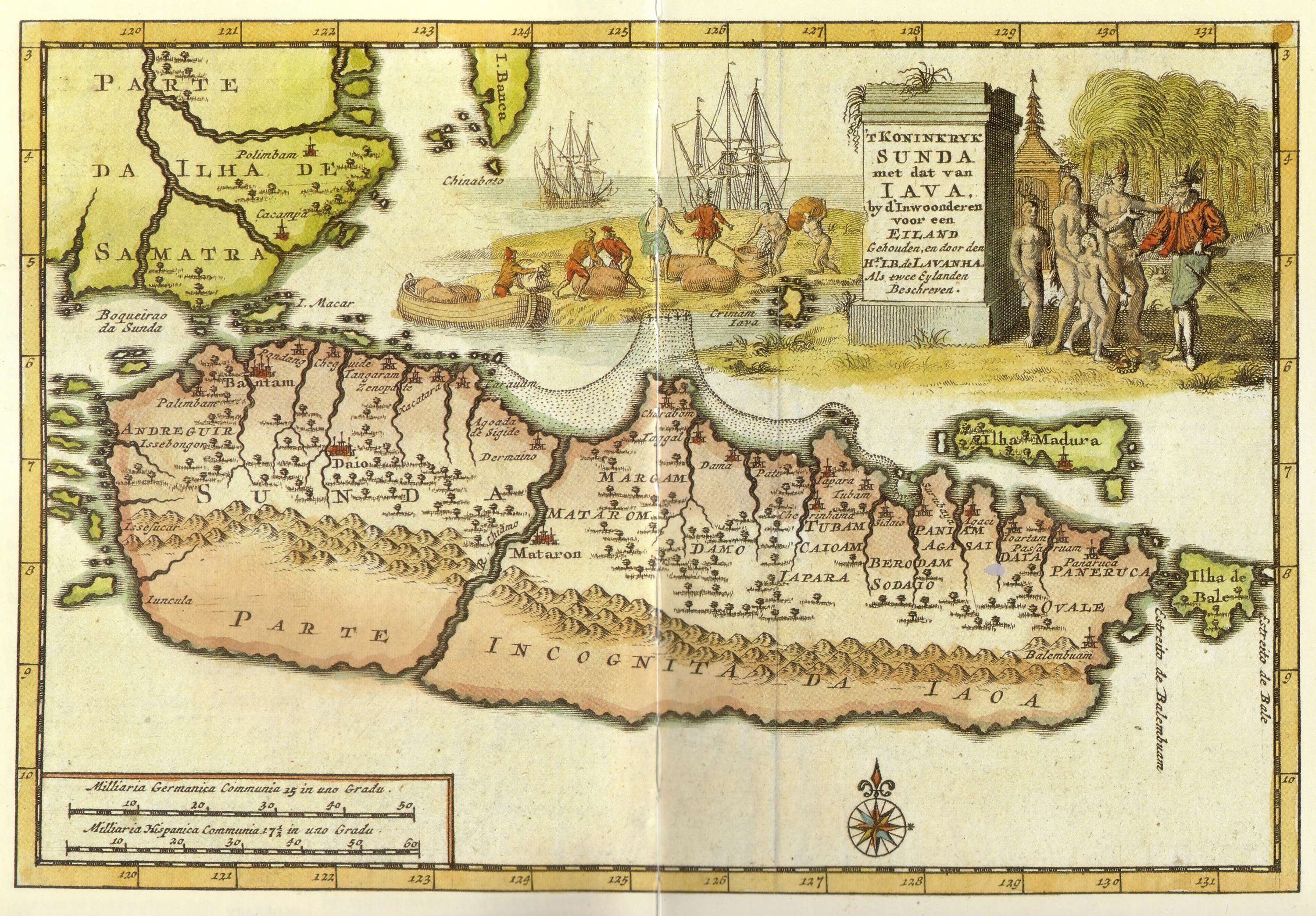
Java Man is the name given to fossils discovered in 1891 at Trinil - Ngawi Regency on the banks of the Solo River in East Java, Indonesia, one of the 1st known specimens of Homo erectus. Its discoverer, Eugxne Dubois, gave it the scientific name Pithecanthropus erectus, a name derived from Greek and Latin roots meaning upright ape-man.
Java ManIn 1887, Eugxne Dubois began to excavate caves in Southeast Asia while working as a military surgeon. Dubois hoped to learn more about human evolution and to discover an ancestor of modern man. With this goal in mind he traveled to Sumatra, but after he failed to find the fossils he was looking for on the island he moved onto Java in 1890. Assisted by convict laborers and two army sergeants, Dubois began searching along the Solo River at Trinil in August of 1891.
Java ManThe new date of the Mojokerto child, Dr. Swisher's group [of the Institute of Human Origins in Berkeley] has determined, is about 1.81 million years, and the Sangiran fossils are about 1.66 million years old.
Until older human remains were discovered in the Great Rift Valley in Kenya, Dubois' and Koenigswald's discoveries were the oldest hominid remains ever found. Some scientists of the day suggested Dubois' Java Man as a potential intermediate form between modern humans and the common ancestor we share with the other great apes. The current consensus of anthropologists is that the direct ancestors of modern humans were African populations of Homo erectus, rather than the Asian populations exemplified by Java Man and Peking Man.

Related Sites for Java Man

  • Java Man - New World Encyclopedia read Java Man
  • Java man (extinct hominid) -- Encyclopedia Britannica read Java Man
  • Who was ‘Java Man’? - Answers in Genesis read Java Man
  • Java man, Other Skulls Found, Arguments about Java Man, Was Java ... read Java Man

Sunday, July 14, 2013

Reformasi : Post-Suharto Began with The Fall of Suharto in 1998

Post-Suharto era


The Post-Suharto era in Indonesia began with the fall of Suharto in 1998 during which Indonesia has been in a period of transition, an era known in Indonesia as Reformasi. A more open and liberal political-social environment ensued following the resignation of authoritarian President Suharto, ending the three decades of the New Order period.
Post-Suharto eraIssues over this period have included a push for a stronger democracy and civilian rule, elements of the military trying to retain their influence, a growing Islamism in politics and society, demands for greater regional autonomy. The process of reformasi in Indonesia has experienced a greater freedom of speech in contrast to a greater censorship under the New Order. This has led to a more open political debate in the news media and increased expression in the arts. Events that have shaped Indonesia in this period include a bombing campaign by Islamic terrorists and the 2004 Indian Ocean earthquake.
Post-Suharto eraThe Reformasi of 1998 led to changes in Indonesia's various governmental institutions, reforms upon the structures of the judiciary, legislature, and executive office. Generally the fall of Suharto in 1998 is traced from events starting in 1996, when forces opposed to the New Order began to rally around Megawati Sukarnoputri, head of the PDI and daughter of the founding president Sukarno. When Suharto attempted to have Megawati removed as head of this party in a back-room deal, student activists loyal to Megawati occupied the headquarters of PDI in Jakarta. This culminated in Black Saturday on July 27, when the Indonesian military broke up the demonstrations.
These actions, along with increasing concerns over human rights violations in Indonesian-occupied East Timor, began to unsettle Suharto's normally friendly relations with Western nations Australia, Great Britain, and the United States. These further worsened when the 1997 Asian financial crisis reached Indonesia, highlighting the corruption of the New Order.
Economic instability from the crisis affected much of the country, in the form of increased prices for staple foods and goods, and lowered standards of living and quality of life. These touched off riots, many targeting ethnic Chinese-Indonesians; bolstered by the findings of Parliamentary and independent investigations, it is often theorized that these anti-Chinese riots were instigated or aided by the military to divert anger away from Suharto himself.
In West Kalimantan there was communal violence between Dayaks and Madurese in 1996, 1999 and 2001, resulting in about 500 deaths.
Growing dissatisfaction with Suharto's authoritarian rule and the rapid erosion of the economy led many, chiefly the younger generation, to renew their protests directly against the New Order. During the years 1997-1998, a massive riot broke out in Indonesia. People were burning everything within the city including cars, motorcycles, buildings, and monuments in addition to pillaging and looting from stores. This was further worsened when many were killed and raped, most of which were Indonesians of Chinese descents. No action was taken by the army or the police. In 1998, Suharto made the decision to stand before the parliament for a re-election and won. The result was considered so outrageous that students occupied the Parliament. Suharto soon stood down from the presidency, and named Jusuf Habibie his successor. Considered the unseen power behind the throne, General Wiranto of the Chief of Staff over the military that was central to the New Order, is believed to have been behind the decision of Suharto to step down.
On Suharto's resignation, Vice President Jusuf Habibie was sworn in as President of Indonesia. As President, Habibie undertook numerous political reforms.
In February 1999, Habibie's Government passed the Political Parties Law. Under this law, political parties were not limited to just three as had been the case under the Suharto regime. Political parties were also not required to have Pancasila as their ideology. This resulted in the emergence of many political parties and 48 would go on to compete in the 1999 Legislative Election.
In May 1999, Habibie's Government passed the Regional Autonomy Law. This law was the 1st step in decentralizing Indonesia's Government and in allowing Provinces to have more part in Governing their Province.
The Press became liberated under Habibie's Government although the Ministry of Information continued to exist.
Habibie also released political prisoners such as Sri Bintang Pamungkas, Muchtar Pakpahan, and Xanana Gusmxo.
Habibie also presided over the 1999 legislative elections, the 1st free election since the 1955 Legislative Election. This election was supervised by the independent General Elections Commission instead of an elections commission filled with government ministers as had been the case during the New Order.
In a move that surprised many, and angered some, Habibie called for a referendum on the future of East Timor. Subsequently, on August 30, the inhabitants of East Timor voted to break away from Indonesian rule and become an independent nation. The territorial loss to Indonesia harmed Habibie's popularity and political alliances.
Following Habibie's presidency, Abdurrahman Wahid and Megawati Sukarnoputri served as president. In 2004 Susilo Bambang Yudhoyono was elected Presidentâ€"a position he has held since. Yudhoyono's coalition, which brings together figures from the military, business community, and conservative Islam, has restabilized the office of the Presidency.
In 1999, Abdurrahman Wahid became President of Indonesia. His 1st Cabinet, dubbed the National Unity Cabinet, was a Coalition Cabinet which consisted of members of various political parties. PDI-P, PKB, Golkar, PPP, PAN, and Justice Party. Non-partisans and the military were also represented in the Cabinet. Wahid then went on to make two administrative reforms. The 1st administrative reform was to abolish the Ministry of Information, the New Order's main weapon in controlling the media while the 2nd administrative reform was to disband the Ministry of Welfare which had become corrupt and extortionist under the New Order.
Wahid's plan in Aceh was to give it a referendum. However, this referendum would be to decide on various modes of autonomy rather than to decide on independence like in East Timor. Wahid also wanted to adopt a softer stance towards Aceh by having less military personnel on the ground. In March, Wahid's Government began to open negotiations with the Free Aceh Movement. Two months later, in May, the Government signed a memorandum of understanding with GAM to last until the beginning of 2001, by which time both signatories would have breached the agreement.
On 30 December, Wahid visited Jayapura the capital of Papua province. During his visit, Wahid was successful in convincing West Papuan leaders that he was a force for change and even encouraged the use of the name Papua.
In September 2000, Wahid declared martial law in Maluku. By now, it was evident that Laskar Jihad were being assisted by members of the military and it was also apparent that they were financed by Fuad Bawazier, the last Minister of Finance to have served under Suharto. During the same month, the West Papuans raised their Morning Star flag. Wahid's response was to allow the West Papuans to do this provided that the Morning Star flag was placed lower than the Indonesian flag For this, he was severely criticized by Megawati and Akbar. On 24 December 2000, a series of bombings were directed against churches in Jakarta and in eight cities across Indonesia.
In March of that year, Wahid suggested that the 1966 Provisional People's Consultative Assembly resolution on the banning of Marxism-Leninism be lifted.
When he ascended to the Presidency, one of Wahid's goals was to reform the military and to take it out of its dominant socio-political role. In this venture, Wahid found an ally in Agus Wirahadikusumah who he made Commander of Kostrad in March. In July, Agus began uncovering a scandal involving Dharma Putra, a foundation with affiliations to Kostrad. Through Megawati, military members began pressuring Wahid to remove Agus. Wahid gave in to the pressure but then planned to have Agus appointed as the Army Chief of Staff to which top military leaders responded by threatening to retire and Wahid once again bowed down to pressure.
Wahid's relationship with the military deteriorated even further when in July it was revealed that Laskar Jihad had arrived in Maluku and was being armed by the military. Laskar Jihad, a radical Islamic militia had earlier in the year planned to go to Maluku and assist Muslims there in their communal conflict with the Christians. Wahid had ordered military to block Laskar Jihad from going to Maluku, but nevertheless they still made it to Maluku and they were then being armed with what turned out to be military weapons.
Wahid embroiled in two scandals which would damage his Presidency. In May, the State Logistics Agency reported that US$4 million was missing from its cash reserve. The missing cash was then attributed to Wahid's own masseur who had claimed that Wahid sent him to Bulog to collect the cash. Although the money was returned, Wahid's opponents took the chance of accusing him of being involved in the scandal and of being aware of what his masseur was up to. At the same time, Wahid was also accused of keeping US$2 million for himself. The money was a donation by the Sultan of Brunei to provide assistance in Aceh. However, Wahid failed to account for the money.
By the end of 2000, there were many within the political elite who were disillusioned with Wahid. The most obvious person who showed this disillusion was Amien Rais who showed regret at supporting Wahid to the Presidency the previous year. Amien also attempted to rally opposition by encouraging Megawati and Akbar to flex their political muscles. Megawati surprisingly defended Wahid whilst Akbar preferred to wait for the 2004 Legislative Elections. At the end of November, 151 DPR members signed a petition calling for the impeachment of Wahid.

Related Sites for Post-Suharto era

Dutch East India Company in Indonesia

Dutch East India Company in Indonesia

Dutch East India Company in Indonesia
The Dutch East India Company had a presence in the Indonesian archipelago from 1603, when the 1st trading post was established, to 1800, when the bankrupted party was dissolved, and its possessions nationalised as the Dutch East Indies.
A 1596 Dutch expedition lost half its crew, killed a Javanese prince and lost a ship but returned to Holland with a load of spices, the profit from which encouraged other expeditions.
Dutch East India Company in IndonesiaRecognising the potential of the East Indies spice trade, and to prevent competition eating into Dutch profits, the Dutch Government amalgamated the competing merchant companies into the United East India Company. In 1602, the States-General of the Netherlands granted it a 21-year monopoly in the spice trade in Asia. It was awarded quasi-governmental powers, including the ability to wage war, imprison and execute convicts, negotiate treaties, coin money, and establish colonies.
Dutch East India Company in IndonesiaIn 1603, the 1st permanent Dutch trading post in Indonesia was established in Banten, northwest Java and in 1611, another was established at Jayakarta.
VOC headquarters were in Ambon from 1610 to 1619, and although it was located centrally in the spice production areas, it was far from the Asian trade routes and other VOC activity ranging from Africa to Japan. A location in the west of the archipelago was thus sought; while the Straits of Malacca were strategic, the Portuguese conquest had made them dangerous, and the 1st permanent VOC settlement in Banten was difficult due to control by a powerful local ruler and competition from Chinese and English traders.
In 1604, a 2nd British East India Company voyage to Maluku, and subsequent establishments of trading posts between 1611 and 1617 across the archipelago began Anglo-Dutch competition for access to spices as the Dutch monopolistic ambitions were threatened. Diplomatic agreements and cooperation between the Dutch and the English over the spice trade ended with the Amboyna massacre where ten Englishmen were tortured and killed for conspiracy against the Dutch government, following which the English withdrew from their Indonesian activities.
In 1619, Jan Pieterszoon Coen was appointed Governor-General of the VOC. On 30 May 1619, Coen, backed by a force of nineteen ships, stormed Jayakarta driving out the Banten forces, and from the ashes, established Batavia as the VOC headquarters. Coen's plans had included making Batavia the centre of intra-Asian trade from Japan to Persia and to Burmese, Madagascan and Chinese labour to develop the spice trade. Although this plan was never realised, Coen managed to establish a Dutch monopoly of the spice trade through an alliance with the Sultan of Ternate in 1607 to control the production of cloves, and the occupation of the Banda Islands gave control of the nutmeg trade. The Dutch captured Melaka from the Portuguese in 1641 giving them control of the region's seas.
By the mid-seventeenth century Batavia had become an important trade center. It had repelled attacks from the Javanese Mataram kingdom. The Dutch defeated the Sulawesi city of Makassar in 1667 thus bringing its trade under VOC control. Sumatran ports were also brought under VOC control and the last of the Portuguese were expelled in 1660. In return for monopoly control over the pepper trade and the expulsion of the British, the Dutch helped the son of the ruler of Banten overthrow his father in 1680.
VOC policy at this time was to concentrate on its trading posts and to not become involved in costly territorial conquest. However, the company became deeply involved in the internal politics of Java in this period, and fought in a number of wars involving the leaders of Mataram and Banten. The VOC reached an accord with the susuhunan (king) of Mataram, Java's dominant kingdom, that only allowed Dutch ships to trade within the archipelago.
Although they failed to gain complete control of the Indonesian spice trade, they had much more success than the previous Portuguese efforts. They exploited the factionalisation of the small kingdoms in Java that had replaced Majapahit, establishing a permanent foothold in Java, from which grew a land-based colonial empire which became one of the world's richest colonial possessions.
VOC personnel lived separate to indigenous Indonesians, and Dutch people ranked low in indigenous status systems. As such, while the VOC introduced objects, techniques, corporate organisation into Indonesian society, its impact on Indonesian thinkers was minimal. Rather, at a time when Europe was denouncing autocratic rule, hierarchy and hereditary rights, the VOC borrowed these values from Indonesian societies. Governors-general acted like royalty and didn't leave the enclaves they had established, and like Indonesian royalty, they employed the local nobility and Chinese agents to organise labour.

Related Sites for Dutch East India Company in Indonesia

Sang Saka Merah-Putih, The National Flag of Indonesia

Flag of Indonesia


The national flag of Indonesia, which is known as Sang Saka Merah-Putih or Bendera Merah-Putih ("The Red-and-White Flag") or simply Merah-Putih ("The Red-and-White"), or sometimes referred to as Sang Dwiwarna ("The Bicolor") in Indonesian is based on the banner of the 13th century Majapahit Empire in East Java. The flag itself was introduced and h
oisted in public at the Indonesian Independence Day ceremony, on 17 August 1945. The design of the flag has remained the same ever since.
The design of the flag is simple with two equal horizontal bands, red and white (bottom) with an overall ratio of 2:3. The flag is similar to the flag of Poland and flag of Singapore. The flag is identical to the flag of Hesse (a German state) and the flag of Monaco, excluding the ratio. Red represents courage, while white represents purity of intent.
The Naval Jack of Indonesia is reserved for sole use by Indonesian Navy. It flies from every active Indonesian war ship mast. The design of the jack is described as nine alternating stripes of red and white. It is nicknamed Ular-ular Perang, probably due to the stripes' design. The naval jack dates to the age of Majapahit Empire. The Majapahit Empire, which was renowned for its great maritime strength, used to fly similar jacks on its vessels.
Its colors are derived from the banner of the 13th century Majapahit Empire. However it was suggested that the reverence for the colors red and white can trace its origin to older common Austronesian mythology of Mother Earth and Father Sky; both symbolize in colors red and white (sky). This is one of the reasons why the colors red and white appears in many of the flags throughout Austronesia â€" from Tahiti to Indonesia and Madagascar. White and Red would also later on symbolize the duality of nature. The earliest record of the use of red and white panji or pataka (long flag along curved bamboo pole) were written in Pararaton; according to this source, the troops of Jayakatwang from Gelang-gelang hoisted the red and white banner during their invasion to Singhasari. This suggested that even before Majapahit era, the red and white colors already revered and used as kingdom's banner since Kediri era. The application of red and white textile coloring is available in ancient Indonesia. White is the natural colour of woven cotton fabrics, while red is one of the earliest natural dye discovered by native acquired from the teak leafs, the flowers of Averrhoa bilimbi or the skin of mangosteen fruits.
Not only Javanese kingdoms that used red and white colors, the battle flag of King Sisingamangaraja IX of Batak lands also uses red and white as emblem; with the image of white twin swords called piso gaja dompak against red background. During Aceh War, Aceh warriors also used red and white battle flag, with the image of sword, star and crescent, sun, and also part of Quranic script. Red and white flag is also used as the flag of Buginese Bone kingdom in South Sulawesi, the flag is called Woromporang. The Balinese Badung royal banner also contains red and white element, their flag is red, white, and black that probably also derived from Majapahit origin. During Java War (1825â€"1830) Prince Diponegoro also used red and white banner.
Flag of IndonesiaLater, these colors were revived by students and then nationalists in the early 20th century as an expression of nationalism against the Dutch. The red-white flag was flown for the 1st time in Java in 1928. Under Dutch rule, the flag was prohibited. It was adopted as the national flag on 17 August 1945, when independence was declared and has been in use since then.
There is also another story about the flag of Indonesia, which is significantly related to the flag of the Netherlands. Under Dutch colonialism, every administration used the Netherlands flag. The flag of Indonesia was prohibited. To symbolize the intention of forcing out the Dutch, the Indonesian nationalists and independence movement tore apart the Dutch flag. They tore off the bottom 3rd of the flag, and separated the red and white colors from the blue color. The famous flag tearing incident called "Hotel Yamato incident" happened in 1945 on top of Hotel Majapahit in downtown Surabaya, where young Indonesian revolutionaries tore the blue part of the Dutch flag flown in the hotel to change it to the Indonesian flag in the lead up to the Battle of Surabaya. The main reason was because blue in the Dutch flag was understood as standing for the "blue blooded" aristocracy of Kingdom of the Netherlands. Conversely, the red colour represented the blood shed in the War of Independence, while the white could be understood to symbolize the purity of the Indonesians.
The official name of the flag is Sang Merah-Putih according to Article 35 of the 1945 Constitution. The flag is commonly called Bendera Merah-Putih (Red-and-White Flag). Occasionally, it is also called Sang Dwiwarna (The bicolor). Sang Saka Merah-Putih (The Lofty Red-and-White) refers to the historical flag called Bendera Pusaka (heirloom flag) and its replica. The Bendera Pusaka is the flag that was flown in front of Soekarno's house a few moments after he proclaimed Indonesia's independence on 17 August 1945. The original Bendera Pusaka was sewn by Mrs. Fatmawati Soekarno, and was hoisted every year in front of the presidential palace during the independence day ceremony. It was hoisted for the last time on 17 August 1968. Since then it has been preserved and replaced by a replica because the original flag was deemed to be too fragile.
Traditionally, most Indonesians have used red and white as their ceremonial colors, mixing the colour of sugar and rice (white in color). Inarguably, until today, both of these are the major components of daily Indonesian cuisine or cooking. The Majapahit Empire have the same colours in its flag.
Several opinions have been expressed on the meaning of the red and white in the Indonesian flag. One opinion is that the red stands for courage, while the white stands for purity. Another is that red represents the human body or physical life, while white represents the soul or spiritual life; together they stand for a complete human being.
Traditionally, most Indonesians have used red and white as their ceremonial colors, mixing the colour of sugar and rice (white in color). Inarguably, until today, both of these are the major components of daily Indonesian cuisine or cooking. The Majapahit Empire have the same colours in its flag.
In 2003, the governor of Jakarta, Sutiyoso announced his plan to relocate the original Bendera Pusaka from the State Palace to the National Monument. For security and financial reasons, the Rp 3.5 billion project was delayed for one year. Of the Rp3.5 billion, only Rp 500 million was allocated for the actual relocation ceremony, while most of the remaining Rp3 billion was spent on procuring around 15 kilograms of gold for the conservation room and on security measures such as alarms and security cameras. The spending was proposed in the 2003 revised city budget. The plan was to install the flag in a 24-carat gold plated case in the Independence Room inside the National Monument. Inside the Independence Room, there are three most important relics from Indonesia's history: the Garuda Pancasila statue, the Nusantara (Archipelago) map and the original text of the Proclamation of Independence, which all are kept in the gold plated cases.
State flag is set according to the Constitution of Indonesia, UUD 1945 pasal 35 State Flag Indonesia is the Red and White, UU No. 24/2009,and government regulation No.40/1958 on National Flag of the Republic of Indonesia.
The flag of Indonesia similar to the flag of Monaco with the same colour but different ratios. Of the Flag of Poland, the flag of Indonesia have the same color, but with the reversed colors. While, the flag of Singapore has a brighter red colour than the flag of Indonesia coupled with the moon and five stars on the upper left side of the flag.


Related Sites for Flag of Indonesia

Monday, June 24, 2013

East Java, Province of Indonesia

East Java

East Java

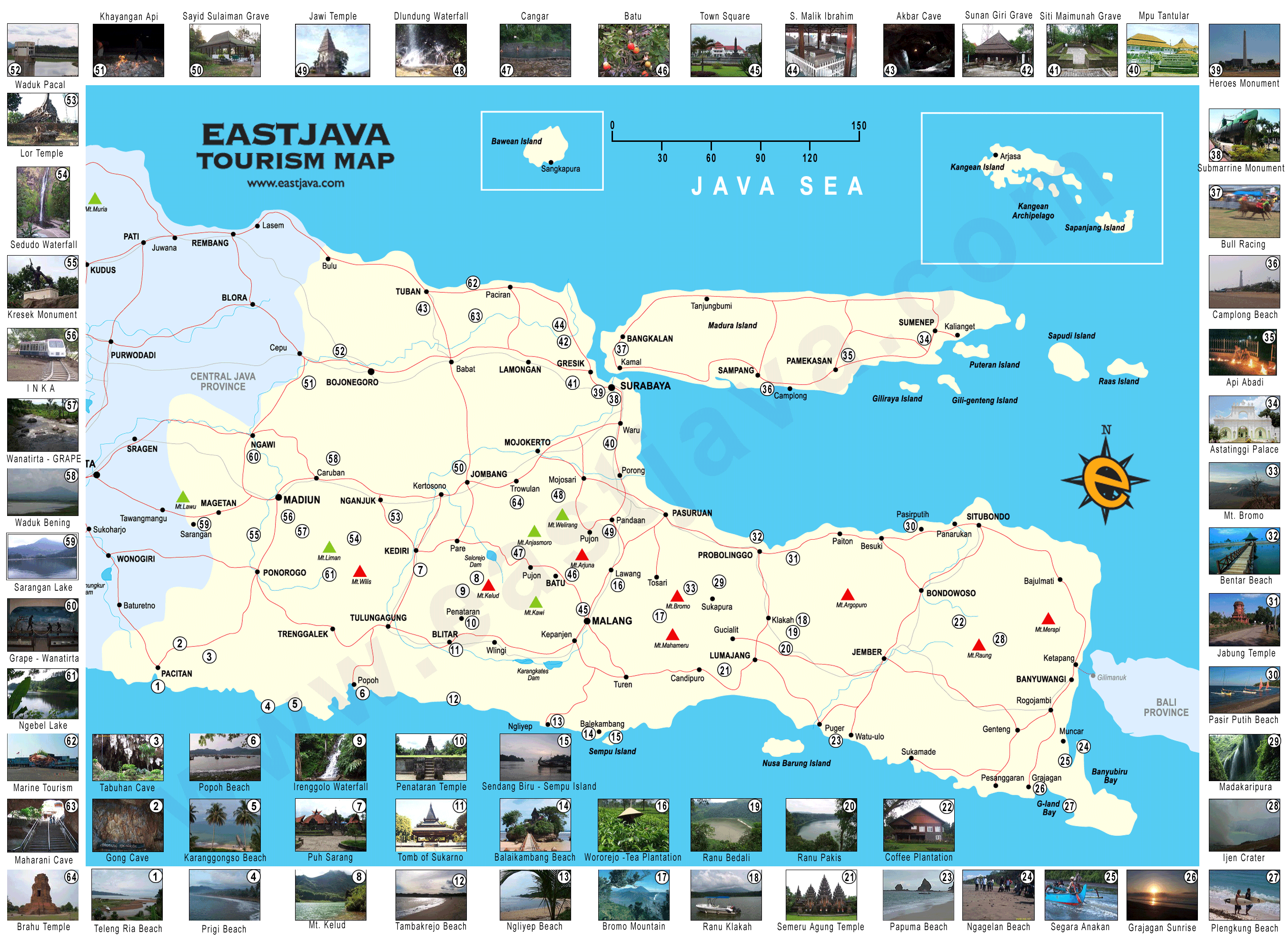
East Java is a province of Indonesia. It is located on the eastern part of the island of Java and includes the neighbouring islands of Madura, and the Kangean, Sapudi, Bawean, and Masalembu groups.
Its capital is Surabaya, the 2nd largest city in Indonesia and a major industrial center and port. It covers an area of 47,922 km2. At the 2010 Census, the province's population was 37,476,000.
It has a land border only with the province of Central Java to the west, being surrounded by sea on all other sides.
East JavaEast Java's history dates back to the famous ancient kingdoms of Kediri and Singosari, which is now a city near Malang. The Majapahit empire, centered at Trowulan, Mojokerto East Java, is celebrated by Indonesians as the golden age of the archipelago. Most of the Eastern Java region was part of the Mataram Kingdom during its peak, apart from the Kingdom of Blambangan at Java's far eastern end nearest to Bali.
East Java is administratively divided into 29 regencies, together with 9 cities (or kotamadya) that are independent of the regency in which they sit.
According to the 2000 census, East Java has 34,765,993 inhabitants, which had increased to 37,476,011 at the 2010 Census, making it the 2nd most populous Indonesian province after West Java. The inhabitants are predominantly ethnically Javanese. Native minorities include migrants from nearby Madura, and distinct Javanese ethnicities such as the Tengger people in Bromo, the Samin and the Osing people in Banyuwangi. East Java also hosts a significant population of other ethnic groups, such as Chinese, Indians, and Arabs. In addition to the national language, Indonesian, they also speak Javanese. Javanese as spoken in the western East Java is a similar dialect to the one spoken in nearby Central Java, with its hierarchy of high, medium, and low registers. In the eastern cities of Surabaya, Malang, and surrounding areas, a more egalitarian version of Javanese is spoken, with less regard for hierarchy and a richer vocabulary for vulgarity.
Hinduism and Buddhism once dominated the island, however Islam, gradually supplanted Hinduism in the 14th and 15th centuries. The last nobles and loyalists of the fallen empire of Majapahit fled from this point to Bali. Islam spread from northern cities in Java where traders from Gujarat, India brought with them Islam. The eastern part of East Java, from Surabaya to Pasuruan, and the cities along the coast, and back to Banyuwangi to Jember, are known as the "horseshoe area" in context with earlier Muslim communities living there.
Pockets of Hinduism
streams of Islam and Hinduism
remain, and syncretic abangan
remain strong.
East Java will build 4
Gresik, Probolinggo and
seaports by 2013 in Lamongan,
Banyuwangi.
Another important form of education that is available in most cities in East Java is the pesantren. This kind of education is built and organized by Islamic clerics, and associated with local or national Muslim organizations. Jombang is a famous city for its pesantren.
East Java supports several regional media outlets. Local newspapers with provincial news reach their readers earlier than their competitors from Jakarta. In the spirit of "providing more news from around readers", most newspapers even issue municipal sections which are different among their distribution areas.
East Java cuisine tends
Central Java.
to be saltier than that of
-

Related Sites for East Java

Monday, June 17, 2013

History of Indonesia

History of Indonesia


History of IndonesiaThe history of Indonesia has been shaped by its geographic position, its natural resources, a series of human migrations and contacts, wars and conquests, as well as by trade, economics and politics. Indonesia is an archipelagic country of 17,508 islands stretching along the equator in South East Asia. The country's strategic sea-lane position fostered inter-island and international trade; trade has since fundamentally shaped Indonesian history. The area of Indonesia is populated by peoples of various migrations, creating a diversity of cultures, ethnicities, and languages. The archipelago's landforms and climate significantly influenced agriculture and trade, and the formation of states. The boundaries of the state of Indonesia represent the twentieth century borders of the Dutch East Indies.
Europeans arrived in Indonesia from the 16th century seeking to monopolise the sources of valuable nutmeg, cloves, and cubeb pepper in Maluku. In 1602 the Dutch established the Dutch East India Company and became the dominant European power by 1610. Following bankruptcy, the VOC was formally dissolved in 1800, and the government of the Netherlands established the Dutch East Indies under government control. By the early 20th century, Dutch dominance extended to the current boundaries. The Japanese invasion and subsequent occupation in 1942-45 during WWII ended Dutch rule, and encouraged the previously suppressed Indonesian independence movement. Two days after the surrender of Japan in August 1945, nationalist leader, Sukarno, declared independence and became president. The Netherlands tried to reestablish its rule, but a bitter armed and diplomatic struggle ended in December 1949, when in the face of international pressure, the Dutch formally recognised Indonesian independence.
In 2003, on the island of Flores, fossils of a new small hominid dated between 74,000 and 13,000 years old and named "Flores Man" were discovered much to the surprise of the scientific community. This 3 foot tall hominid is thought to be a species descended from Homo Erectus and reduced in size over thousands of years by a well known process called island dwarfism. Flores Man seems to have shared the island with modern Homo sapiens until only 12,000 years ago, when they became extinct. In 2010 stone tools were discovered on Flores dating from 1 million years ago, which is the oldest evidence anywhere in the world that early man had the technology to make sea crossings at this very early time.
The archipelago was formed during the thaw after the latest ice age. Early humans to travelled by sea and spread from mainland Asia eastward to New Guinea and Australia. Homo sapiens reached the region by around 45,000 years ago. In 2011 evidence was uncovered in neighbouring East Timor, showing that 42,000 years ago these early settlers had high-level maritime skills, and by implication the technology needed to make ocean crossings to reach Australia and other islands, as they were catching and consuming large numbers of big deep sea fish such as tuna.
Ideal agricultural conditions, and the mastering of wet-field rice cultivation as early as the 8th century BCE, allowed villages, towns, and small kingdoms to flourish by the 1st century CE. These kingdoms evolved with their own ethnic and tribal religions. Java's hot and even temperature, abundant rain and volcanic soil, was perfect for wet rice cultivation. Such agriculture required a well organised society in contrast to dry-field rice which is a much simpler form of cultivation that doesn't require an elaborate social structure to support it.
References to the Dvipantara or Jawa Dwipa Hindu kingdom in Java and Sumatra appear in Sanskrit writings from 200 BCE. The earliest archeological relic discovered in Indonesia is from the Ujung Kulon National Park, West Java, where an early Hindu statue of Ganesha from the 1st century CE was found on the summit of Mount Raksa in Panaitan Island. There is also archeological evidence of a kingdom in Sunda territory in West Java dating from the 2nd century, and according to Dr Tony Djubiantono, the head of Bandung Archeology Agency, Jiwa Temple in Batujaya, Karawang, West Java was also built around this time.
A number of Hindu and Buddhist states flourished and then declined across Indonesia. By the time of the European Renaissance, Java and Sumatra had already seen over a millennium of civilization and two major empires. One such early kingdom was Tarumanagara, which flourished between 358 and 669 CE. Located in West Java close to modern-day Jakarta, its 5th-century king, Purnawarman, established the earliest known inscriptions in Java, the Ciaruteun inscription located near Bogor. On this monument, King Purnavarman inscribed his name and made an imprint of his footprints, as well as his elephant's footprints. The accompanying inscription reads, "Here are the footprints of King Purnavarman, the heroic conqueror of the world". This inscription is in Sanskrit and is still clear after 1500 years. Purnawarman apparently built a canal that changed the course of the Cakung River, and drained a coastal area for agriculture and settlement. In his stone inscriptions, Purnawarman associated himself with Vishnu, and Brahmins ritually secured the hydraulic project.
Three rough plinths dating from the beginning of the 4th century are found in Kutai, East Kalimantan, near Mahakam River. The plinths bear an inscription in the Pallava script of India reading "A gift to the Brahmin priests".
The political history of Indonesian archipelago during the 7th to 11th centuries was dominated by Srivijaya based in Sumatra, also Sailendra that dominated central Java and constructed Borobudur, the largest Buddhist monument in the world. The history of the 14th and 15th centuries isn't well known due to scarcity of evidence. Two major states dominated this period; Majapahit in East Java, the greatest of the pre-Islamic Indonesian states, and Malacca on the west coast of the Malay Peninsula, arguably the greatest of the Muslim trading empires.
Medang or previously known as Mataram was an Indianized kingdom based in Central Java around modern-day Yogyakarta between the 8th and 10th centuries. The center of the kingdom was moved from central Java to east Java by Mpu Sindok. An eruption of Mount Merapi volcano or a power struggle may have caused the move.
The 1st king of Mataram was Sri Sanjaya and left inscriptions in stone. The monumental Hindu temple of Prambanan in the vicinity of Yogyakarta was built by Daksa. Dharmawangsa ordered the translation of the Mahabharata into Old Javanese in 996.
The kingdom collapsed into chaos at the end of Dharmawangsa's reign under military pressure from Srivijaya. One of the last major kings of Mataram was Airlangga who reigned from 1016 until 1049. Airlangga was a son of Udayana of Bali and a relative of Dharmawangsa re-established the kingdom including Bali under the name of Kahuripan.
Srivijaya was centred in the coastal trading centre of present day Palembang. Srivijaya wasn't a "state" in the modern sense with defined boundaries and a centralized government to which the citizens own allegiance. Rather Srivijaya was a confederacy form of society centered on a royal heartland. It was a thalassocracy and didn't extend its influence far beyond the coastal areas of the islands of Southeast Asia. Trade was the driving force of Srivijaya just as it is for most societies throughout history. The Srivijayan navy controlled the trade that made its way through the Strait of Malacca.
By the 7th century, the harbors of various vassal states of Srivijaya lined both coasts of the Straits of Melaka. Around this time, Srivijaya had established suzerainty over large areas of Sumatra, western Java, and much of the Malay Peninsula. Dominating the Malacca and Sunda straits, the empire controlled both the Spice Route traffic and local trade. It remained a formidable sea power until the 13th century. This spread the ethnic Malay culture throughout Sumatra, the Malay Peninsula, and western Borneo. A stronghold of Vajrayana Buddhism, Srivijaya attracted pilgrims and scholars from other parts of Asia.
A series of Chola raids in the 11th century weakened the Srivijayan hegemony and enabled the formation of regional kingdoms based, like Kediri, on intensive agriculture rather than coastal and long distance trade. Srivijayan influence waned by the 11th century. The island was in frequent conflict with the Javanese kingdoms, 1st Singhasari and then Majapahit. Islam eventually made its way to the Aceh region of Sumatra, spreading its influence through contacts with Arabs and Indian traders. By the late 13th century, the kingdom of Pasai in northern Sumatra converted to Islam. At that time Srivijaya was briefly a tributary of the Khmer empire and later the Sukhothai kingdom. The last inscription dates to 1374, where a crown prince, Ananggavarman, is mentioned. Srivijaya ceased to exist by 1414, when Parameswara, the kingdom's last prince, converted to Islam and founded the Sultanate of Malacca on the Malay peninsula.
Despite a lack of historical evidence, it is known that Majapahit was the most dominant of Indonesia's pre-Islamic states. The Hindu Majapahit kingdom was founded in eastern Java in the late 13th century, and under Gajah Mada it experienced what is often referred to as a "Golden Age" in Indonesian history, when its influence extended to much of southern Malay Peninsula, Borneo, Sumatra, and Bali from about 1293 to around 1500.
The founder of the Majapahit Empire, Kertarajasa, was the son-in-law of the ruler of the Singhasari kingdom, also based in Java. After Singhasari drove Srivijaya out of Java in 1290, the rising power of Singhasari came to the attention of Kublai Khan in China and he sent emissaries demanding tribute. Kertanagara, ruler of the Singhasari kingdom, refused to pay tribute and the Khan sent a punitive expedition which arrived off the coast of Java in 1293. By that time, a rebel from Kediri, Jayakatwang, had killed Kertanagara. The Majapahit founder allied himself with the Mongols against Jayakatwang and, once the Singhasari kingdom was destroyed, turned and forced his Mongol allies to withdraw in confusion.
The earliest accounts of the Indonesian archipelago date from the Abbasid Caliphate, according to those early accounts the Indonesian archipelago were famous among early muslim sailors mainly due to its abundance of precious spice trade commodities such as nutmeg, cloves, galangal and many other spices.
Although Muslim traders 1st traveled through South East Asia early in the Islamic era, the spread of Islam among the inhabitants of the Indonesian archipelago dates to the 13th century in northern Sumatra. Although it is known that the spread of Islam began in the west of the archipelago, the fragmentary evidence does not suggest a rolling wave of conversion through adjacent areas; rather, it suggests the process was complicated and slow. The spread of Islam was driven by increasing trade links outside of the archipelago; in general, traders and the royalty of major kingdoms were the 1st to adopt the new religion.
Other Indonesian areas gradually adopted Islam, making it the dominant religion in Java and Sumatra by the end of the 16th century. For the most part, Islam overlaid and mixed with existing cultural and religious influences, which shaped the predominant form of Islam in Indonesia, particularly in Java. Only Bali retained a Hindu majority. In the eastern archipelago, both Christian and Islamic missionaries were active in the 16th and 17th centuries, and, currently, there are large communities of both religions on these islands.
The Sultanate of Mataram was the 3rd Sultanate in Java, after the Sultanate of Demak Bintoro and the Sultanate of Pajang.
According to Javanese records, Kyai Gedhe Pamanahan became the ruler of the Mataram area in the 1570s with the support of the kingdom of Pajang to the east, near the current site of Surakarta. Pamanahan was often referred to as Kyai Gedhe Mataram after his ascension.
Pamanahan's son, Panembahan Senapati Ingalaga, replaced his father on the throne around 1584. Under Senapati the kingdom grew substantially through regular military campaigns against Mataram's neighbors. Shortly after his accession, for example, he conquered his father's patrons in Pajang.
The reign of Panembahan Seda ing Krapyak, the son of Senapati, was dominated by further warfare, especially against powerful Surabaya, already a major center in East Java. The 1st contact between Mataram and the Dutch East India Company (VOC) occurred under Krapyak. Dutch activities at the time were limited to trading from limited coastal settlements, so their interactions with the inland Mataram kingdom were limited, although they did form an alliance against Surabaya in 1613. Krapyak died that year.

Related Sites for History of Indonesia

Sunday, October 16, 2011

Indonesian Cuisine

Indonesian cuisine

Indonesian cuisine
Indonesian cuisine is diverse, in part because Indonesia is composed of approximately 6,000 of the total 18,000 inhabited island in the world's largest archipelago. Many regional cuisines exist, often based upon cultural and foreign influences. Indonesian cuisine varies greatly by region and has many different influences.
Indonesian cuisineThroughout its history, Indonesia has been involved in trade due to its location and natural resources. Additionally, Indonesia’s indigenous techniques and ingredients were influenced by India, the Middle East, China, and finally Europe. Spanish and Portuguese traders brought New World produce even before the Dutch came to colonize most of the archipelago. The Indonesian islands The Moluccas , which are famed as "the Spice Islands", also contributed to the introduction of native spices, such as cloves and nutmeg, to Indonesian and global cuisine.
Some popular
goreng, gado-gado, sate, and
country and considered as
Indonesian dishes such as nasi
soto are ubiquitous in the
Indonesian national dishes.
Some popular dishes
Indonesia are now common across
Indonesian dishes such as satay,
also favoured in Malaysia
dishes, such as variations of
popular. Tempe is regarded as a
adaptation of soy-based food
Another fermented food is
tempe but using a variety of
by different fungi, and
that originated in
much of Southeast Asia.
beef rendang, and sambal are
and Singapore. Soy-based
tofu and tempe, are also very
Javanese invention, a local
fermentation and production.
oncom, similar in some ways to
bases (not only soy), created
particularly popular in West Java.
Indonesian meals are commonly eaten with the combination of a spoon in the right hand and fork in the left hand , although in many parts of the country, such as West Java and West Sumatra, it is also common to eat with one's hands. In restaurants or households that commonly use bare hands to eat, like in seafood foodstalls, traditional Sundanese and Minangkabau restaurants, or East Javanese pecel lele (fried catfish with sambal) and ayam goreng (fried chicken) food stalls, they usually serve kobokan, a bowl of tap water with a slice of lime in it to give a fresh scent. This bowl of water should not to be consumed, however; it is used to wash one's hand before and after eating. Eating with chopsticks is generally only found in food stalls or restaurants serving Indonesian adaptations of Chinese cuisine, such as bakmie or mie ayam (chicken noodle) with pangsit (wonton), mie goreng (fried noodles), and kwetiau goreng (fried flat rice noodles).
Rice is a staple for all
Indonesia, and it holds the central
it shapes the landscape;
served in most meals both as a
importance of rice in Indonesian
through the reverence of Dewi
ancient Java and Bali.
cycles linked to rice
through rituals, such as Seren
classes in contemporary
place in Indonesian culture:
is sold at markets; and is
savoury and a sweet food. The
culture is demonstrated
Sri, the rice goddess of
Traditionally the agricultural
cultivations were celebrated
Taun rice harvest festival.
Rice is most often eaten
few protein and vegetable
also served, however, as
cooked with coconut milk and
in woven packets of
steamed in banana leaves),
crackers), desserts, vermicelli,
and nasi goreng (fried
omnipresent in Indonesia and
as plain rice with just a
dishes as side dishes. It is
nasi uduk , nasi kuning (rice
turmeric), ketupat (rice steamed
coconut fronds), lontong (rice
intip or rengginang (rice
noodles, arak beras (rice wine),
rice). Nasi goreng is
considered as national dish.
Rice was only incorporated into diets, however, as either the technology to grow it or the ability to buy it from elsewhere was gained. Evidence of wild rice on the island of Sulawesi dates from 3000 BCE. Evidence for the earliest cultivation, however, comes from eighth century stone inscriptions from the central island of Java, which show kings levied taxes in rice. The images of rice cultivation, rice barn, and mouse pest investing a ricefield is evident in Karmawibhanga bas-reliefs of Borobudur. Divisions of labour between men, women, and animals that are still in place in Indonesian rice cultivation, were carved into relief friezes on the ninth century Prambanan temples in Central Java: a water buffalo attached to a plough; women planting seedlings and pounding grain; and a man carrying sheaves of rice on each end of a pole across his shoulders . In the sixteenth century, Europeans visiting the Indonesian islands saw rice as a new prestige food served to the aristocracy during ceremonies and feasts.
Rice production in
development of iron tools and the
Buffalo as water buffalo for
fertilizer. Rice production
Once covered in dense
landscape has been gradually
and settlements as rice
fifteen hundred years.
Indonesian history is linked to the
domestication of Wild Asian Water
cultivation of fields and manure for
requires exposure to the sun.
forest, much of the Indonesian
cleared for permanent fields
cultivation developed over the last
-
Other staple foods in
starchy tubers such as; yam,
and cassava; also starchy
jackfruit and grains such as maize
called Papeda is a staple food
Sago is also often mixed with
pancake. Next to sago, people of
various kind of wild tubers as
Indonesia include a number of
sweet potato, potato, taro
fruit such as breadfruit and
and wheat. A sago congee
especially in Maluku and Papua.
water and cooked as a simple
eastern Indonesia also consume
staple food.
Many types of tubers such as talas and breadfruit are native to Indonesia, while others are introduced from elsewhere. Wheat, the base ingredient for bread and noodles were probably introduced from India or China; yam was introduced from Africa; while maize, potato, sweet potato, cassava and maize were introduced from Americas through Spanish influence and finally reached Java in 17th century. Cassava is usually boiled, steamed, fried or processed as popular snack kripik singkong (cassava crackers). Dried cassava, locally known as tiwul, is an alternate staple food in arid areas of Java such as Gunung Kidul and Wonogiri, while other roots and tubers are eaten especially in hard times. Maize is eaten in drier regions such as Madura and islands east of the Wallace Line, such as the Lesser Sunda Islands.
A number of leaf vegetables are widely used in Indonesian cuisine, such as kangkung, spinach, genjer, melinjo, papaya and cassava leaves. These are often sauteed with garlic. Spinach and corn are used in simple clear watery vegetable soup sayur bayam bening flavoured with temu kunci, garlic and shallot. Other vegetables like labu air , labu siam (chayote), kelor, kacang panjang (yardlong bean), terung (eggplant), gambas and belustru, are cut and used in stir fries, curries and soups like sayur asem, sayur lodeh or laksa. Sayur sop is cabbage, cauliflower, potato, carrot, with macaroni spiced with black pepper, garlic and shallot in chicken or beef broth. The similar mixed vegetables are also stir fried as cap cai, a popular dish of the Chinese Indonesian cuisine.
Vegetables like
(cucumber) and the small variety of
commonly eaten raw, like in
variety is usually boiled.
are a common Indonesian
spiced shredded coconut meat
vegetables, asinan betawi are
and pecel are a salad of
peanut-based spicy sauce, while
kecipir , tomato, mentimun
peria (bitter melon) are
lalab. The large bitter melon
kecombrang and papaya flower buds
vegetable. Urap is seasoned and
mixed together with
preserved vegetables. Gado-gado
boiled vegetables dressed in a
karedok is its raw version.
The main meat source diet mostly are poultry and fish, however meats such as beef, water buffalo, goat and mutton are commonly found in Indonesian marketplaces. The most common poultry consumed is chicken and duck, however to a lesser amount, pigeon and wild migrating sea bird are also consumed. As a country with an Islamic majority, Indonesian Muslims follows the Islamic halal dietary law which forbids the consumption of pork. However in other parts of Indonesia where there are significant numbers of non-Muslims, boar and pork are commonly consumed. Dishes made of non-halal meats can be found in provinces such as Bali, North Sumatra, North Sulawesi, East Nusa Tenggara, Maluku, West Papua, Papua, and also in Chinatowns in major Indonesian cities. Today to cater for the larger Muslim market, most of the restaurants and eating establishments in Indonesia put halal signs that signify they neither serve pork nor use lard in their cooking.
The meat can be cooked in
such as beef, goat or lamb
grilled chicken or mutton as
sliced and cooked in rich broth
various offals can be use as
curry. In Bali, with its Hindu
popular among locals as well as
Batak people of North Sumatra
similar dish. The meat also can
thinly-sliced and dried as dendeng
floss). Dendeng celeng is
meat.
rich spices and coconut milk
rendang, skewered, seasoned and
satay, barbecued meats, or
soup as soto. Muttons and
ingredients for soto soup or gulai
majority, the babi guling is
non-Muslim visitors, while the
have babi panggang that is a
be processed to be
(jerky), or made into abon (meat
Indonesian "dried, jerked" boar
-
As an archipelagic nation, seafood is abundant and commonly consumed especially by Indonesian resides in coastal areas. Popular seafood in Indonesian cuisine among others; mackerel, tuna, wahoo, milkfish, red snapper, anchovy, cuttlefish, shrimp, crab and mussel. Seafood is commonly consumed across Indonesia, but it is especially popular in Maluku islands and Minahasa cuisine. Seafood are usually being bakar (grilled), rebus (boiled) or goreng (fried). However another method of cooking like stir fried in spices or in soup is also possible. Ikan asin (salted fish) is preserved seafood through cured in salt, it is also can be found in Indonesian market. Fresh water fisheries can be found in inland region or area with large rivers or lakes. Popular fresh water fish among others; carp, gourami, snakehead, tilapia, catfish and pangasius.
Rempah" is Indonesian word for spice, while "bumbu" is the Indonesian word for spices mixture or seasoning, and it commonly appears in the names of certain spice mixtures, sauces and seasoning pastes. Known throughout the world as the "Spice Islands", the Indonesian islands of Maluku contributed to the introduction of its native spices to world cuisine. Spices such as pala , cengkeh (clove), and laos (galangal) are native to Indonesia. It is likely that lada hitam (black pepper), kunyit (turmeric), sereh (lemongrass), bawang merah (shallot), kayu manis (cinnamon), kemiri (candlenut), ketumbar (coriander), and asam jawa (tamarind) were introduced from India, while jahe (ginger), daun bawang (scallions) and bawang putih (garlic) were introduced from China. Those spices from mainland Asia were introduced early, in ancient times, thus they became integral ingredients in Indonesian cuisine.
In ancient times, the kingdom of Sunda and the later sultanate of Banten were well known as the world's major producers of black pepper. The maritime empires of Srivijaya and Majapahit also benefited from the lucrative spice trade between the spice islands with China and India. Later the Dutch East India Company controlled the spice trade between Indonesia and the world. The Indonesian fondness for hot and spicy food was enriched when the Spanish introduced cabai chili pepper from the New World to the region in 16th century. After that hot and spicy sambals have become an important part of Indonesian cuisine. Sambal evolved into many variants across Indonesia, ones of the most popular is sambal terasi and sambal mangga muda (young mango sambal). Dabu-dabu is North Sulawesi style of sambal with chopped fresh tomato, chili, and lime juice. Traditionally prepared laboriously ground upon stone mortar, today sambals is also available as industrial processed products in bottles or jars.
Soy sauce is also an
Indonesian cuisine. Kecap asin was
however Indonesian developed
soy sauce) with generous
sauce. Sweet soy sauce is an
meat and fish, such as satay
soy sauce is also an
Indonesian stew.
important flavorings in
adopted from Chinese cuisine,
their own kecap manis (sweet
addition of palm sugar into soy
important marinade for barbecued
and grilled fishes. Sweet
important ingredient for semur,
-
One of the main characteristics of Indonesian cuisine is the wide application of peanuts in many Indonesian signature dishes, such as satay, gado-gado, karedok, ketoprak, and pecel. Gado-gado and Sate for example have been considered as Indonesian national dishes. Introduced from Mexico by Portuguese and Spanish merchants in 16th century, peanuts assumed a place within Indonesian cuisine as a key ingredient. Peanuts thrived in the tropical environment of Southeast Asia, and today they can be found, roasted and chopped finely, in many recipes. Whole, halved, or crushed peanuts are used to garnish a variety of dishes, and used in marinades and dipping sauces such as sambal kacang for otak-otak or ketan. Peanut oil, extracted from peanuts, is one of the most commonly used cooking oils in Indonesia.
Bumbu kacang or peanut sauce represents a sophisticated, earthy seasoning rather than a sweet, gloppy sauce. It should have a delicate balance of savoury, sweet, sour, and spicy flavours, acquired from various ingredients, such as fried peanuts, gula jawa , garlic, shallots, ginger, tamarind, lemon juice, lemongrass, salt, chilli, peppercorns, sweet soy sauce, ground together and mixed with water to form the right consistency. The secret to good peanut sauce is “not too thick and not too watery.” Indonesian peanut sauce tends to be less sweet than the Thai version, which is a hybrid adaptation. Gado-gado is a popular dish particularly associated with bumbu kacang, and is eaten across Indonesia.
The use of coconut milk
Indonesian cuisine. It can also be
Thai, Malaysian, Filipino,
Nonetheless, the use of coconut milk
Indonesia, especially in
Minahasan cuisine, coconut milk
except in Minahasan cakes and
isn't exclusive to
found in Indian, Samoan,
and Brazilian cuisines.
is quite extensive in
Minangkabau cuisine, although in
is generally absent,
desserts such as klappertart.
In Indonesian cuisine,
are found, thin coconut
The difference depends on
Thin coconut milk is usually
lodeh and soto, while the
rendang and desserts. It can be
coconut meat in traditional
processed in cartons at the
two types of coconut milk
milk and thick coconut milk.
the water and oil content.
used for soups such as sayur
thicker variety is used for
made from freshly shredded
markets, or can be found
supermarket.

Related Sites for Indonesian cuisine